


A school day puts demands on earbuds that a commute never does: six to eight hours away from a charger, a backpack that crushes whatever settles at the bottom, a gym class, a wet walk home, and video lessons where the microphone matters more than the bass. We ranked ten pairs of wireless earbuds for school on the criteria that decide whether a pair survives a semester: fit type and how quickly a student can hear a teacher again, single-charge battery measured against the length of a school day, water and dust protection, weight per earbud, microphone quality for online classes, switching between a phone and a school laptop, and what it costs to replace one earbud after it disappears.
Smart Choice
TREBLAB WX8
Wireless earbuds for School
Extended battery & Wireless charging
Discover crystal-clear sound for up to 28 hrs with the WX8 Bluetooth wireless earbuds with charging case. Charge the headphones in just 1 hr with wireless or USB-C, and store 4 charges in each case.
Cozy & Ergonomic
Immerse yourself in a world of sound with comfortable wireless ear buds built for all-day use. Choose from 3 sizes of silicone tips to create a custom fit that blocks outside noise.
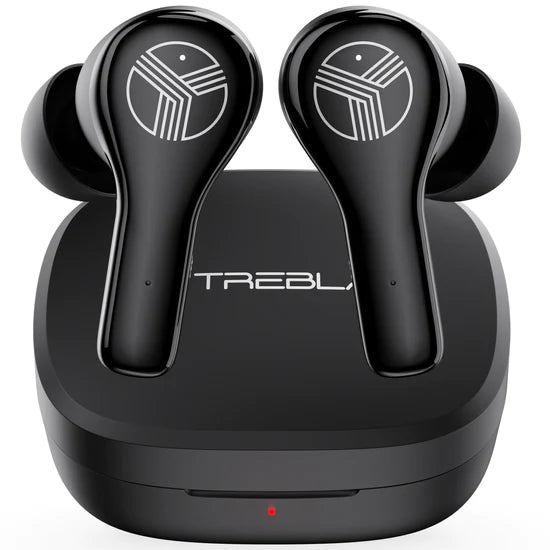
Two models mark the outer edges of this list. Sony's WF-1000XM6 sells for $329.99 and delivers the strongest noise cancellation of anything here. The TREBLAB WX8 sells for $29.99 and handles the parts of a school day that have nothing to do with noise cancellation: rain, sweat, seven hours of playback per charge, and the moment one earbud rolls under a bus seat. The other eight sit somewhere between those two positions.
What Makes Wireless Earbuds Work for School?

Earbuds work for school when they last a full day away from a charger, stay put through a hallway sprint and a PE session, let a student hear a teacher within a second or two, transmit a clear voice on a video call, and cost little enough that losing one ruins an afternoon rather than a month.
The Shape of a School Day
A student wearing earbuds at school uses them in short bursts spread across a long stretch: twenty minutes on the bus, a recorded lecture in the library, a video assignment in class, music during independent work, a call to a parent after last period, then the gym or the walk home. Single-charge battery life matters more than the headline total because the case usually stays in a locker or bag while the earbuds are in use. A pair rated for five hours per charge will need a midday top-up; a pair rated for seven to twelve will not.
Four Fit Types and What Each One Does in a Classroom
Sealed in-ear models insert a silicone tip into the ear canal, blocking out external sound before any electronics are involved. They give the best isolation at the lowest volume, and they take a second to remove when a teacher starts talking. Wingtip models add a small silicone fin that braces against the ear, which keeps them anchored during sport without adding much weight. Ear-hook models loop over the ear and stay locked in through almost anything, at the cost of bulk and visibility. Open-ear models sit entirely outside the ear canal, leave the ear open to the room, and suit students who need to hear everything around them, though they leak sound to neighbors and lose their punch in a noisy cafeteria.
Why Full Noise Cancellation Can Work Against a Student
Active noise cancellation solves a problem students have during independent study and creates one during instruction. A student wearing noise-canceling, sealed earbuds while running will miss a question directed at them, an intercom announcement, or a car approaching a crosswalk. Every pair on this list with cancellation also has a transparency mode that pipes the room back in, and learning to switch modes matters more than the decibel figure on the box. Schools also set their own rules on earbud use during class, so the handbook is worth checking before the purchase rather than after.
What Actually Ends a Pair of School Earbuds
Water and pressure account for most of the damage. Rain on the walk home, sweat during PE, a bottle leaking inside a backpack, and the weight of textbooks pressing on a case in a side pocket all take their toll long before a battery wears out. The IP rating tells you how much of that a pair can tolerate: IPX4 covers splashes and sweat, IP55 adds dust and low-pressure water jets, and IP66 and IPX8 go further still. Loss ranks second, and it is worth pricing honestly, because a single replacement earbud from a premium brand can cost more than an entire budget pair.
Wireless Earbuds for School Compared

|
Model |
Fit Type |
Noise Control |
Battery (buds / total) |
Weight per Bud |
IP Rating |
Price |
|
Sony WF-1000XM6 |
Sealed in-ear |
Adaptive ANC, QN3e processor |
8 h / 24 h |
6.5 g |
IPX4 |
$329.99 |
|
TREBLAB WX8 |
Sealed in-ear |
Passive isolation |
7 h / 28 h |
4.4 g |
IPX8 |
$29.99 |
|
Beats Powerbeats Fit |
In-ear + wingtip |
ANC + Transparency |
6 h ANC on, 7 h off / 24 h ANC on, 30 h off |
5.78 g |
IPX4 |
$199.99 |
|
JBL Live Beam 3 |
Sealed in-ear (stem) |
Adaptive ANC, 4 sensing mics |
12 h ANC off / 48 h |
Not published |
IP55 |
$149.95 |
|
EarFun Air Pro 4+ |
Sealed in-ear (stem) |
Adaptive ANC |
8 h ANC on, 12 h off / 54 h |
~5 g |
IP55 |
$99.99 |
|
CMF Buds Pro 2 |
Sealed in-ear (stem) |
Hybrid ANC, up to 50 dB |
6.5 h ANC on, 11 h off / 43 h |
4.5 g |
IP55 |
$59.00 |
|
Nothing Ear (a) |
Sealed in-ear (stem) |
Adaptive ANC, up to 45 dB |
5.5 h ANC on, 9.5 h off / 24.5 h ANC on, 42.5 h off |
4.8 g |
IP54 (case IPX2) |
$99.00 |
|
Soundcore Liberty 4 NC |
Sealed in-ear (stem) |
Adaptive ANC 2.0 |
10 h normal mode / 50 h |
Not published |
IPX4 |
$99.99 |
|
JLab Epic Air Sport ANC |
Ear-hook in-ear |
Hybrid ANC + Be Aware mode |
11 h ANC on, 15 h off / 70 h |
10 g |
IP66 |
$99.95 |
|
Shokz OpenFit Pro |
Open-ear hook |
Open-ear noise reduction |
12 h off, 6 h on / 50 h off, 24 h on |
12.3 g |
IP55 (case not rated) |
$249.95 |
The 10 Best Wireless Earbuds for School Reviewed
Each pair below was assessed against the same school-day checklist: hours per charge, protection rating, weight, microphone performance during video lessons, how quickly a student can hear the room again, and the cost of a replacement. Specifications come from manufacturer pages and measured reviews.
Sony WF-1000XM6: Best Premium Pick

Rating: ⭐⭐⭐⭐⭐
Sony's February 2026 flagship pairs a QN3e processor with four microphones per earbud, and the result cancels more noise than anything else on this list. The housing is about 11 percent slimmer than the WF-1000XM5, which helps during long wear. Water protection stayed at IPX4, so rain and gym sessions call for care.
Detailed Specifications:
- Fit Type: Sealed in-ear
- Driver Size: 8.4 mm
- Bluetooth Version: 5.3
- Battery Life (earbuds): 8 h with noise cancellation on
- Battery Life (total with case): 24 h
- Weight (per earbud): 6.5 g
- Water Resistance: IPX4
- Microphone: 4 per earbud, beamforming with bone conduction sensor
- Charging: USB-C and Qi wireless
- Price: $329.99
+ Pros:
- Strongest noise cancellation here
- Eight hours per charge
- Bone conduction mic for calls
- LDAC and LE Audio support
- Ten-band equalizer in the app
- Slimmer housing than the predecessor
- Qi wireless charging
- Cons:
- Most expensive pair listed
- IPX4 only, no dust rating
- No aptX codec
- One replacement bud costs more than most rivals
- Case total trails cheaper models
Why it's our choice for school:
The eight-hour charge lasts through any school day, and the microphone array handles video lessons better than any other pair here. Cancellation this strong needs discipline in class, and the price makes a lost earbud a genuine problem.
TREBLAB WX8: Best Value Pick for School

Rating: ⭐⭐⭐⭐⭐
At 4.4 g per earbud, the WX8 is the lightest pair in this guide, and seven hours of battery life per charge covers a full timetable without a midday top-up. The IPX8 rating is the highest here, which matters for rain, sweat, and a leaking water bottle in a backpack. Noise reduction is passive, handled by the silicone tips.
Detailed Specifications:
- Fit Type: Sealed in-ear
- Driver Size: Not published
- Bluetooth Version: 5.1
- Battery Life (earbuds): 7 h
- Battery Life (total with case): 28 h
- Weight (per earbud): 4.4 g
- Water Resistance: IPX8
- Microphone: 2-mic array
- Charging: USB-C and wireless, full case charge in about 1 h
- Price: $29.99
+ Pros:
- Lightest earbud on this list
- IPX8, highest rating here
- Seven hours per charge
- Wireless charging at $29.99
- Three silicone tip sizes
- Replacement cost near zero
- Student discount via Student Beans
- Cons:
- Passive isolation only
- Bluetooth 5.1 is a generation behind
- No companion app or equalizer
Why it's our choice for school:
Seven hours per charge outlast the Nothing Ear (a), the CMF Buds Pro 2, and the Powerbeats Fit with cancellation running, IPX8 survives the walk home, and a lost earbud costs about fifteen dollars to replace instead of a hundred and sixty.
Beats Powerbeats Fit

Rating: ⭐⭐⭐⭐
Beats rebuilt the Fit Pro with a more flexible wingtip and a case 17 percent smaller. The wingtip braces inside the outer ear and holds through sport without an over-ear hook. Apple's older H1 chip runs the show, so spatial audio and transparency work well while call quality stays ordinary.
Detailed Specifications:
- Fit Type: In-ear with wingtip
- Driver Size: Not published
- Bluetooth Version: Class 1 Bluetooth, Apple H1 chip
- Battery Life (earbuds): 6 h with cancellation on, 7 h off
- Battery Life (total with case): 24 h with cancellation on, 30 h off
- Weight (per earbud): 5.78 g
- Water Resistance: IPX4, case also IPX4
- Microphone: 6 mics, dual beamforming
- Charging: USB-C, no wireless charging
- Price: $199.99
+ Pros:
- Wingtip holds during sport
- Four ear tip sizes are included
- Works on iPhone and Android
- Water-resistant case
- Spatial audio with head tracking
- A five-minute charge gives an hour
- Cons:
- Older H1 chip, no H2 features
- Average microphone quality
- No wireless charging
- Six hours with cancellation on
- Full price sits near $200
Why it's our choice for school:
The wingtip suits students who move between class, practice, and the gym in one day. Six hours with cancellation running means a top-up before evening, and the two-hundred-dollar price raises the stakes on a crowded bus.
JBL Live Beam 3

Rating: ⭐⭐⭐⭐
The case features a 1.45-inch touchscreen that controls volume, the equalizer, and noise cancellation without using a phone, which is useful when phone use is restricted during lessons. Adaptive cancellation runs on four sensing microphones. Twelve hours per charge and IP55 protection are enough for a demanding week.
Detailed Specifications:
- Fit Type: Sealed in-ear with stem
- Driver Size: 10 mm dynamic
- Bluetooth Version: 5.3
- Battery Life (earbuds): 12 h with cancellation off
- Battery Life (total with case): 48 h
- Weight (per earbud): Not published
- Water Resistance: IP55
- Microphone: 6 beamforming mics
- Charging: USB-C and wireless, 10 min gives 4 h
- Price: $149.95
+ Pros:
- Touchscreen case, no phone needed
- Twelve hours per charge
- IP55 dust and water rating
- LDAC and multipoint support
- Six mics for lessons and calls
- Wireless charging included
- Cons:
- The case is bulky in a pocket
- Cancellation trails Sony noticeably
- Fit is inconsistent on some ears
- Feature menus take time to learn
- Weight per bud not published
Why it's our choice for school:
Twelve hours per charge, and the IP55 rating handles a full week of classes and weather. The case screen lets a student change settings without pulling out a phone, which helps in schools that restrict phone use during lessons.
EarFun Air Pro 4+

Rating: ⭐⭐⭐⭐
A hybrid driver pairs a 10 mm dynamic unit with a balanced armature, and the codec list includes LDAC, aptX Lossless, LC3, and Auracast. Fifty-four hours of total playback and IP55 protection put this under a hundred dollars with very little missing.
Detailed Specifications:
- Fit Type: Sealed in-ear with stem
- Driver Size: 10 mm dynamic plus balanced armature
- Bluetooth Version: 6.0
- Battery Life (earbuds): 8 h with cancellation on, 12 h off
- Battery Life (total with case): 54 h
- Weight (per earbud): About 5 g
- Water Resistance: IP55
- Microphone: 6 mics, AI Clear Call
- Charging: USB-C and wireless, 10 min gives 3 h
- Price: $99.99
+ Pros:
- Eight hours with cancellation on
- IP55 rating under $100
- Ten-band equalizer, thirty presets
- Bluetooth 6.0 and multipoint
- Wireless charging at this price
- Frequently discounted below $80
- Cons:
- LDAC conflicts with multipoint
- Microphone below flagship level
- Case larger than most rivals
- Design is anonymous
- App settings overwhelm beginners
Why it's our choice for school:
Eight hours with cancellation running clears a school day with margin, and IP55 covers rain and sweat. The equalizer and game mode matter less at school than the fact that nothing here needs to be replaced for two or three years.
CMF Buds Pro 2

Rating: ⭐⭐⭐⭐
Nothing's budget-brand fitted dual drivers, 50 dB hybrid noise cancellation, and LDAC into a fifty-nine-dollar pair. The metal dial on the case adjusts volume, playback, and listening modes by touch, without opening an app. At 4.5 g, the earbuds sit close to the lightest here.
Detailed Specifications:
- Fit Type: Sealed in-ear with stem
- Driver Size: 11 mm dynamic plus 6 mm tweeter
- Bluetooth Version: 5.3
- Battery Life (earbuds): 6.5 h with cancellation on, 11 h off
- Battery Life (total with case): 43 h with cancellation off
- Weight (per earbud): 4.5 g
- Water Resistance: IP55
- Microphone: 6 mics
- Charging: USB-C only, no wireless charging
- Price: $59.00
+ Pros:
- Strong cancellation for $59
- Physical dial on case
- Only 4.5 g per earbud
- IP55 dust and water rating
- Dual drivers at a budget price
- Multipoint and in-ear detection
- Cons:
- Six and a half hours with cancellation
- LDAC destabilizes the connection
- No wireless charging
- Plastic build feels light
- The microphone is adequate rather than good
Why it's used for school:
Fifty-nine dollars buys real cancellation and a tactile dial that works with gloves or cold hands. The six-and-a-half-hour figure means a charge before the last period on longer days.
Nothing Ear (a)

Rating: ⭐⭐⭐⭐
The transparent housing and yellow colorway made these a campus favorite, and the pinch controls on the stem avoid the accidental taps that plague touch panels. Cancellation reaches 45 dB. Battery is the weak spot: five and a half hours with cancellation falls short of a full school day.
Detailed Specifications:
- Fit Type: Sealed in-ear with stem
- Driver Size: 11 mm dynamic
- Bluetooth Version: 5.3
- Battery Life (earbuds): 5.5 h with cancellation on, 9.5 h off
- Battery Life (total with case): 24.5 h with cancellation on, 42.5 h off
- Weight (per earbud): 4.8 g
- Water Resistance: IP54 earbuds, IPX2 case
- Microphone: 3 per earbud with Clear Voice
- Charging: USB-C only, no wireless charging
- Price: $99.00
+ Pros:
- Pinch controls avoid accidental taps
- Light at 4.8 g
- LDAC and multipoint
- Distinctive transparent design
- Strong cancellation for the price
- Low-latency mode for video
- Cons:
- Five and a half hours with cancellation
- Case rated only IPX2
- No wireless charging
- Connection stutters reported on iPhone
- Needs a midday top-up
Why it's our choice for school:
Comfortable, light, and cheap enough to replace, with cancellation that holds up in a busy library. The IPX2 rating makes a wet backpack a real risk, and the battery will not last a long day without a charge.
Soundcore Liberty 4 NC

Rating: ⭐⭐⭐⭐
Anker's sub-brand claims up to 98.5 percent noise reduction based on its own measurements, and independent testing puts its noise cancellation at the top of the sub-hundred-dollar class. Ten hours per charge, fifty in total, plus wireless charging and four ear tip sizes for fitting smaller ears.
Detailed Specifications:
- Fit Type: Sealed in-ear with stem
- Driver Size: 11 mm
- Bluetooth Version: 5.3
- Battery Life (earbuds): 10 h in normal mode, about 8 h with cancellation on
- Battery Life (total with case): 50 h in normal mode
- Weight (per earbud): Not published
- Water Resistance: IPX4
- Microphone: 6 beamforming mics with AI processing
- Charging: USB-C and wireless, 10 min gives 4 h
- Price: $99.99
+ Pros:
- Ten hours per charge
- Best cancellation under $100
- Four ear tip sizes
- Wireless charging included
- LDAC and multipoint
- Twenty-two equalizer presets
- Cons:
- IPX4 only, no dust rating
- Call clarity drops in wind
- Bass-heavy default tuning
- Fit slips for some ears
- Weight per bud not published
Why it's our choice for school:
Ten hours per charge and the strongest cancellation available under a hundred dollars make this the study-focused pick. IPX4 covers light showers and sweat, but falls short of what a rainy walk home demands.
JLab Epic Air Sport ANC

Rating: ⭐⭐⭐⭐
Ear hooks and an IP66 rating make these the most physically durable pair here, and the case carries seventy hours of playback with an integrated cable. The trade-offs land on call quality and cancellation, both of which sit below the sub-hundred-dollar average.
Detailed Specifications:
- Fit Type: Ear-hook in-ear
- Driver Size: Not published
- Bluetooth Version: Bluetooth 5, Class 1
- Battery Life (earbuds): 11 h with cancellation on, 15 h off
- Battery Life (total with case): 70 h
- Weight (per earbud): 10 g
- Water Resistance: IP66
- Microphone: 6 MEMS mics with 2-mic noise canceling
- Charging: Integrated USB-A cable in case, plus wireless charging
- Price: $99.95
+ Pros:
- IP66, dust-tight
- Seventy hours total playback
- Ear hooks never slip
- Six tip options, including foam
- Two-year warranty
- Charging cable built into the case
- Cons:
- Poor call quality
- Weak cancellation for the price
- Ten grams per earbud
- No USB-C port
- Large case, SBC and AAC only
Why it's our choice for school:
Built for students whose day ends at practice. IP66 shrugs off sweat and dust, the hooks hold through anything, and the weak microphone makes these a poor match for regular video lessons.
Shokz OpenFit Pro

Rating: ⭐⭐⭐⭐
The first Shokz open-ear model with noise reduction leaves the ear canal free, so a student hears the teacher, the intercom, and approaching traffic without removing anything. Reduction dampens midrange noise such as chatter and ventilation hum, and does little against low-frequency sound. Sound leaks to nearby desks at a higher volume.
Detailed Specifications:
- Fit Type: Open-ear hook
- Driver Size: Not published
- Bluetooth Version: 6.1
- Battery Life (earbuds): 12 h with reduction off, 6 h on
- Battery Life (total with case): 50 h off, 24 h on
- Weight (per earbud): 12.3 g
- Water Resistance: IP55 earbuds, case not rated
- Microphone: Triple-mic system with AI processing
- Charging: USB-C and Qi wireless, 10 min gives 4 h
- Price: $249.95
+ Pros:
- The ear canal stays open
- Twelve hours per charge
- Physical buttons, not touch
- Titanium hooks, secure fit
- Bluetooth 6.1 with multipoint
- Best-sounding open-ear pair tested
- Cons:
- Reduction halves battery life
- The charging case is not water-resistant
- Microphone worse than OpenFit 2
- Pressure sensation reported by testers
- Costs $249.95
Why it's our choice for school:
The only pair here that keeps a student fully aware of the classroom and the road home. Leakage rules it out for quiet study spaces, and the price sits above every alternative except the Sony.
How to Choose Wireless Earbuds for School

Start with the number of hours the earbuds last on a single charge, because that single figure determines whether a student spends the afternoon listening or hunting for an outlet. Everything else on the spec sheet adjusts the experience; the battery decides whether there is one.
Start with Fit Type
A sealed silicone tip blocks the most sound at the lowest volume, protecting hearing during long sessions and keeping music out of a neighbor's desk. Wingtips and ear hooks add stability for students who go straight from class to practice, at the cost of extra bulk. Open-ear designs leave the ear canal open for anyone who needs to hear announcements and traffic, though they leak sound at higher volumes. Try all the included tip sizes before deciding a pair does not fit, and do not assume both ears take the same size.
Choose Noise Control You Can Switch Off
Active noise cancellation earns its place during independent study in a loud room, and gets in the way during a lesson. Every pair here with cancellation also carries a transparency mode, and the speed of switching matters more than the decibel rating on the box. Passive isolation from a good tip seal handles hallway chatter without any electronics and without cutting a student off from the teacher. Students who study mostly in quiet rooms are paying for a feature they will rarely turn on.
Match Battery to the Longest Block of the Day
Compare hours per charge against the longest stretch a student spends away from the case, then treat the case total as a weekly buffer. Five and a half hours from the Nothing Ear (a) with cancellation running will not reach the end of a long timetable; seven from the WX8, eight from the Sony and the EarFun, and ten from the Liberty 4 NC will. Fast charging changes the maths when there is a break: ten minutes in the case buys three to four hours on most models here. Case totals from 43 to 70 hours mean a charge once or twice a week rather than nightly.
Set a Minimum on Water and Dust Protection
The first digit of an IP rating covers dust, and the second covers water, with an X meaning that side was never tested. IPX4 handles sweat and a light shower, which suits a student who goes from home to class and back. IP55 adds dust protection and low-pressure jets; IP66 goes further, and IPX8 covers full immersion. For a backpack that carries a water bottle and is left outside in the rain, anything below IP55 is asking for trouble.
What $330 Buys That $30 Does Not
Sony's extra three hundred dollars buys adaptive noise cancellation on eight microphones, a bone conduction sensor for calls, LDAC streaming, and one additional hour of battery life per charge. Those are real advantages, and they matter most in a loud library or on a long commute. The same money does not buy better protection (IPX4 vs. the WX8's IPX8), a lighter earbud (6.5 g vs. 4.4 g), or more total playback time (24 hours vs. 28). It also does not buy a replacement policy for the earbud that falls out on a school bus, where a single Sony bud costs more than five complete pairs of the TREBLAB.
FAQ
Are wireless earbuds allowed in school?
Policies vary by district and often by individual teacher, with many schools permitting earbuds during independent work and restricting them during instruction. Check the student handbook before buying, since some schools ban visible earbuds entirely and others require them to be out during passing periods for safety.
Do students really need noise cancellation for school?
Cancellation helps in shared study spaces, dorm lounges, and on public transport, where a steady layer of background noise competes with lecture audio. In a quiet classroom or library, a well-fitted silicone tip does most of the work through passive isolation alone. Students who study in quiet rooms can put that money toward battery life and durability instead.
Do wireless earbuds work with a Chromebook or school laptop?
Any Bluetooth-capable Chromebook or laptop pairs with every model in this guide. Multipoint models such as the JBL Live Beam 3, EarFun Air Pro 4+, and Soundcore Liberty 4 NC stay connected to a phone and a laptop at once, eliminating the need to re-pair when a lesson starts. Older school laptops without Bluetooth need a USB adapter.
Are cheap wireless earbuds for school worth it?
The gap between budget and premium narrowed sharply over the past two years, and the parts of a school day that break earbuds are rarely the parts a flagship improves. A $29.99 pair with IPX8 protection, 4.4 g housings, and seven hours per charge keeps pace with a $329.99 flagship. Premium money buys cancellation strength and microphone quality, not durability or battery.
What water resistance rating should school earbuds have?
IPX4 is the practical minimum, covering sweat and light rain. IP55 or higher is the safer choice for students who walk to school, carry a water bottle in the same compartment, or use the earbuds for sport. Check the case rating separately, since the Nothing Ear (a) case is rated only IPX2 and the Shokz case carries no rating at all.
How long should wireless earbuds last for a full school day?
Seven hours per charge covers a standard six- to eight-hour timetable with the case as backup, and anything under six hours will need a top-up before the last period. Students who listen continuously during study halls and commutes should consider the 10-hour Liberty 4 NC or the 12-hour JBL Live Beam 3. Case totals matter less, since most students charge at home overnight anyway.
Conclusion
The best wireless earbuds for school are the ones that last all day, withstand the weather, and cost little enough to lose. Sony's WF-1000XM6 sets the technical ceiling at $329.99 with cancellation that nothing else here matches, and for most students, that ceiling sits well above what a school day actually requires. The TREBLAB WX8 meets those requirements for $29.99: seven hours per charge, IPX8 waterproofing that outranks every other pair listed, 4.4 g housings that are the lightest here, and wireless charging that models three times the price still lack. The trade is passive isolation rather than active cancellation, which costs a student far less than a lost earbud.
Choose differently when one part of the day dominates. Students working in loud shared spaces should take the Soundcore Liberty 4 NC for its 10-hour battery life and the strongest noise cancellation under $100, or the EarFun Air Pro 4+ if IP55 protection and 8 hours with noise cancellation running matter more. Athletes who go straight from class to practice want the JLab Epic Air Sport ANC for its IP66 rating and ear hooks, accepting weak call quality in return. Anyone who needs to hear the room at all times should look at the Shokz OpenFit Pro, and anyone deciding purely on features per dollar should compare the CMF Buds Pro 2 at $59 against the two flagships before spending more.


