


Rock recordings stack two or three guitar tracks, a bass, a kick drum, and a lead vocal into the same narrow band between roughly 100 Hz and 2 kHz, and most wireless earbuds respond by turning that band into a single blurred mass. The picks below were each judged on the same parameters: tuning shape, driver size and material, transient behavior in fast picking and kick patterns, passive isolation and active noise cancellation, codec support, weight per earbud, battery life on a single charge and with the case, water resistance rating, and price. Prices are manufacturer list prices at the time of writing and drop regularly at retail.
Smart Choice
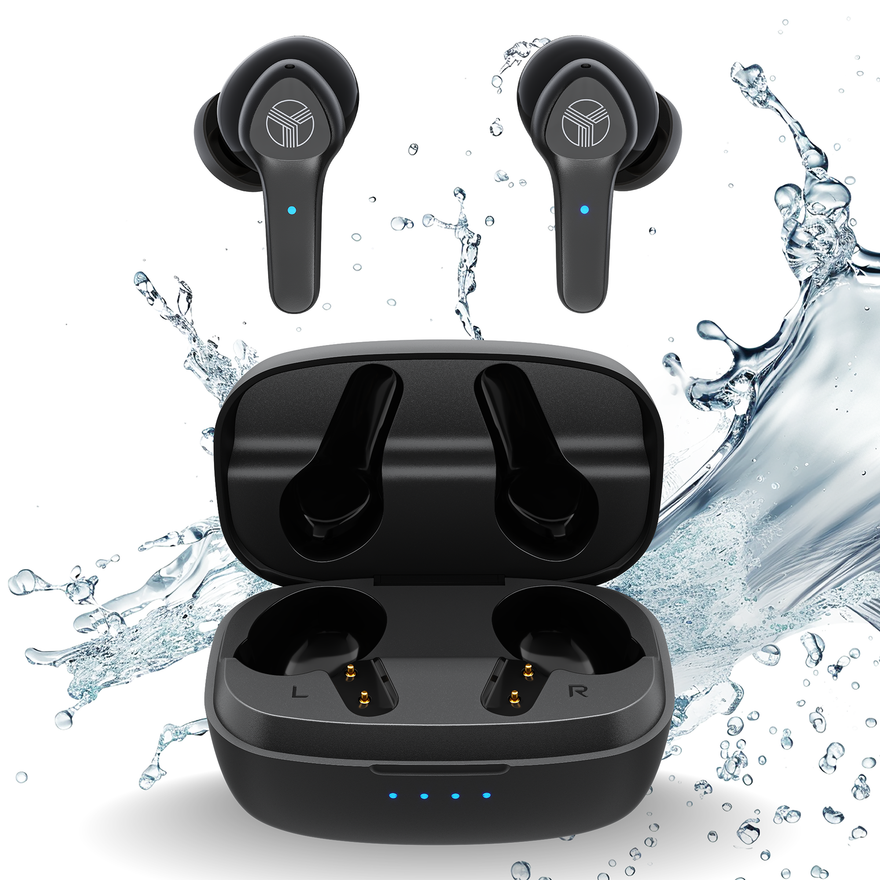
TREBLAB X9-Pro
Earbuds for Rock Music
Extended battery & Wireless charging
Discover crystal-clear sound for up to 50 hrs with the best wireless headphones, X9-Pro. Charge the headphones in just 1 hr with wireless or USB-C, and store 4 charges in each case.
Cozy & Ergonomic
Immerse yourself in a world of sound with the best headphones built for all-day use. Choose from 3 sizes of silicone tips to create a custom fit that blocks outside noise.
What Makes Wireless Earbuds Work for Rock Music?

A pair of earbuds suits rock when it keeps the low-mid range clean under load, reproduces fast attacks without smearing them together, and holds its composure at the volumes rock listeners actually use. Those three requirements decide almost everything else, including which tuning profiles are usable and which ones fall apart on a Led Zeppelin remaster or a modern metalcore mix.
The sections below break the problem into parts and then sort tuning profiles into those that survive a dense rock mix and those that do not.
The Frequency Problem Rock Creates
High-gain guitar amplification concentrates enormous energy between 100 Hz and 500 Hz. The bass guitar sits in the same place. So does the body of the kick drum. When an earbud has a bass boost that extends upward into that region, all three sources merge, and the riff loses its outline.
The second pressure point sits higher up. Cymbal wash and guitar harmonics live between 6 kHz and 12 kHz, and rock albums from the loudness-war era were mastered with those frequencies already pushed hard. An earbud that adds another treble lift on top will produce listening fatigue within about twenty minutes.
Timing matters as much as tone. A thrash riff played at 200 beats per minute contains a pick attack every 75 milliseconds, and drivers that recover slowly turn those individual attacks into a continuous buzz. Larger drivers with rigid diaphragm materials, such as titanium coating, ceramic, or carbon, generally control this better than soft plastic diaphragms of the same size.
Tuning Shapes That Work for Rock
A mild V-shape works well: bass lifted below roughly 100 Hz, a flat or barely recessed midrange, and a gentle treble lift that stops short of the 8 kHz region. The sub-bass boost gives kick drums physical weight while leaving room for the guitars to speak.
Neutral tunings with strong upper-midrange presence also perform well, particularly on classic rock and progressive recordings where the production is cleaner, and the arrangements are wider. Anything with app-based parametric equalization belongs in this category too, since you can correct a boosted low-mid band yourself in about two minutes.
Tuning Shapes That Fail
Heavy bass tunings that extend the boost above 150 Hz are the most common failure. They flatter hip-hop and electronic production, then swallow rhythm guitars whole.
Warm tunings with a lifted 200 Hz- 400 Hz region cause the same problem from the other direction. This range is already congested in high-gain guitar production, and extra energy there makes the mix sound thick and slow.
The third failure mode is a sharp peak somewhere between 6 kHz and 9 kHz. It reads as detail on a short listen in a shop, then becomes painful on cymbal-heavy material within half an album.
Wireless Earbuds for Rock Music Compared

All ten models below are true wireless designs with active noise cancellation, listed in the order they are reviewed later in this guide.
|
Model |
Fit Type |
Driver |
ANC |
Battery (buds / total) |
Codecs |
Price |
|
Bowers & Wilkins Pi8 |
Sealed, oval body |
12 mm carbon cone |
Hybrid, adaptive |
6.5 h / 20 h |
SBC, AAC, aptX Adaptive, aptX Lossless |
$399 |
|
TREBLAB X9-Pro |
Sealed, stem |
10 mm dynamic |
Hybrid, up to −35 dB |
10 h / 50 h |
Bluetooth 5.3, SBC and AAC |
$49.99 |
|
Nothing Ear |
Sealed, stem |
11 mm ceramic |
Adaptive, up to −45 dB |
5.2 h / 40.5 h |
SBC, AAC, LDAC, LHDC 5.0 |
$149 |
|
Beats Fit Pro |
Sealed, wingtip |
Custom dynamic |
Adaptive |
6 h / 24 h |
SBC, AAC |
$199 |
|
Anker Soundcore Liberty 5 |
Sealed, stem |
9.2 mm wool-paper |
Adaptive 3.0 |
8 h / 32 h |
SBC, AAC, LDAC |
$129 |
|
Technics EAH-AZ100 |
Sealed, concha-fit |
10 mm magnetic fluid |
Adaptive |
10 h / 28 h |
SBC, AAC, LDAC, LC3 |
$299 |
|
Denon PerL Pro |
Sealed, disc with wings |
10 mm triple-layer titanium |
Adaptive |
8 h / 32 h |
SBC, AAC, aptX Adaptive, aptX Lossless |
$349 |
|
Jabra Elite 10 Gen 2 |
Semi-open |
10 mm dynamic |
Advanced ANC |
6 h / 27 h |
SBC, AAC, LE Audio |
$279 |
|
JBL Live Beam 3 |
Sealed, stem |
10 mm dynamic |
True adaptive |
10 h / 40 h |
SBC, AAC, LDAC |
$199 |
|
EarFun Air Pro 4 |
Sealed, stem |
10 mm composite |
Adaptive, up to −50 dB |
11 h / 52 h |
SBC, AAC, LDAC, aptX Lossless |
$89 |
Across the ten, the TREBLAB X9-Pro offers the best balance of driver size, isolation, and playing time for its price, which is why it ranks second on a list headed by a $399 flagship.
The 10 Best Wireless Earbuds for Rock Music, Reviewed
Each model below was assessed on the same rock-specific criteria: how cleanly it keeps the 100 Hz to 500 Hz band separated, how quickly it recovers between fast attacks, how much outside noise it blocks before you reach for the volume, and its cost. Sound descriptions reflect measured frequency-response work and reviewer consensus.
Bowers & Wilkins Pi8 - Best Premium Pick

Rating: ⭐⭐⭐⭐⭐
The Pi8 uses a 12 mm carbon cone driver taken from the Px8 over-ear headphone, which is unusually large for a true wireless design. Rigid diaphragm material plus that surface area produces the cleanest guitar and cymbal separation in this group. The charging case doubles as a transmitter, converting a wired input into an aptX Adaptive stream.
Detailed Specifications:
- Fit Type: Sealed in-ear, oval body
- Driver Size: 12 mm carbon cone
- Bluetooth Version: 5.4
- Battery Life (earbuds): 6.5 hours with noise cancellation on
- Battery Life (total with case): 20 hours
- Weight (per earbud): 7 g
- Water Resistance: IP54
- Microphone: 3 per earbud
- Charging: USB-C, wireless charging, case audio retransmission
- Price: $399
+ Pros:
- 12 mm carbon cone driver
- aptX Lossless at 24-bit/96 kHz
- Outstanding instrument separation
- Case works as transmitter
- Five-band equalizer in app
- Four ear tip sizes
- Cons:
- $399 list price
- 6.5 hours per charge
- 20 hours total, below category average
- 7 g per earbud, heavy
- aptX Lossless needs a Snapdragon Sound phone
Why it's our choice for rock music:
The large carbon driver keeps rhythm guitars, bass, and kick drum audibly separate on dense mixes where smaller drivers merge them. Cymbal decay stays clean at high volume. Battery life restricts it to shorter listening blocks.
TREBLAB X9-Pro - Best Value for Rock Music

Rating: ⭐⭐⭐⭐⭐
The TREBLAB X9-Pro pairs a 10 mm driver with hybrid noise cancellation rated at 35 dB and 50 hours of total playing time, at roughly one-eighth of the Pi8's price. Reviewers describe a clear midrange with restrained treble and moderate rather than exaggerated bass, which is the profile rock benefits from. Each earbud weighs 4.2 g.
Detailed Specifications:
- Fit Type: Sealed in-ear, stem
- Driver Size: 10 mm dynamic
- Bluetooth Version: 5.3
- Battery Life (earbuds): 10 hours
- Battery Life (total with case): 50 hours
- Weight (per earbud): 4.2 g
- Water Resistance: IPX6
- Microphone: 6 with AI noise suppression
- Charging: USB-C, 10 W wireless charging
- Price: $49.99
+ Pros:
- 10 mm driver at $49.99
- 50 hours total playtime
- Hybrid noise cancellation, 35 dB
- 4.2 g per earbud
- IPX6, highest rating here
- Clear midrange, restrained treble
- Cons:
- SBC and AAC only, no high-resolution codec
- No app equalizer
- Bass extension below premium models
Why it's our choice for rock music:
Rock needs midrange clarity and a seal that holds, and both arrive here for $49.99. The tuning keeps guitars upfront rather than burying them under sub-bass, and 50 hours of playback covers a week of album listening between charges.
Nothing Ear

Rating: ⭐⭐⭐⭐
An 11 mm ceramic diaphragm driver, LDAC and LHDC 5.0 support, and one of the more capable equalizer apps in the price bracket. Measurements show a bass lift between 20 Hz and 100 Hz with a dip near 500 Hz, which the advanced equalizer can partly correct. Noise cancellation reaches 45 dB.
Detailed Specifications:
- Fit Type: Sealed in-ear, stem
- Driver Size: 11 mm ceramic
- Bluetooth Version: 5.3
- Battery Life (earbuds): 5.2 hours with noise cancellation on
- Battery Life (total with case): 40.5 hours
- Weight (per earbud): 4.6 g
- Water Resistance: IP54 earbuds, IP55 case
- Microphone: 6 total
- Charging: USB-C, wireless charging
- Price: $149
+ Pros:
- Ceramic diaphragm, low distortion
- LDAC and LHDC 5.0
- Advanced parametric equalizer
- Bass lift stays in sub-bass
- 4.6 g per earbud
- Cons:
- 5.2 hours with noise cancellation
- Dip around 500 Hz
- Ceramic driver rewards good seal
- Case rated IP55, earbuds IP54
How it handles rock music:
The sub-bass emphasis sits below the guitar range, so kick drums gain weight without clouding riffs. The 500 Hz dip pushes rhythm guitars slightly back, correctable in three minutes with the equalizer.
Beats Fit Pro

Rating: ⭐⭐⭐⭐
Built around the Apple H1 chip with a flexible wingtip that anchors the earbud in the outer ear. Measurements consistently show a scoop between roughly 100 Hz and 600 Hz, which lifts perceived bass by lowering the region where rhythm guitars live. No user equalizer exists in iOS settings.
Detailed Specifications:
- Fit Type: Sealed in-ear, wingtip
- Driver Size: Custom dynamic driver, size not published
- Bluetooth Version: Class 1 Bluetooth, Apple H1 chip
- Battery Life (earbuds): 6 hours with noise cancellation on
- Battery Life (total with case): 24 hours
- Weight (per earbud): 5.6 g
- Water Resistance: IPX4 earbuds, case not rated
- Microphone: 3 per earbud
- Charging: USB-C, no wireless charging
- Price: $199
+ Pros:
- Wingtip holds through movement
- Apple H1 device switching
- Spatial audio with head tracking
- Adaptive equalization active by default
- Works on Android via Beats app
- Cons:
- Scooped 100 Hz to 600 Hz
- No built-in equalizer
- 24 hours total only
- Case has no water rating
- No wireless charging
How it handles rock music:
The midrange scoop works against dense guitar mixes: riffs recede while bass appears larger. It suits movement and workouts. For critical rock listening, a third-party equalizer app becomes necessary.
Anker Soundcore Liberty 5

Rating: ⭐⭐⭐⭐
A 9.2 mm wool-paper driver with dual bass tubes, LDAC support, and an eight-hour rating with noise cancellation active. Reviewers describe the default tuning as bass-heavy, though the Soundcore app carries a full equalizer and the HearID hearing test. Six ear tip sizes ship in the box.
Detailed Specifications:
- Fit Type: Sealed in-ear, stem
- Driver Size: 9.2 mm wool-paper composite
- Bluetooth Version: 5.4
- Battery Life (earbuds): 8 hours with noise cancellation on
- Battery Life (total with case): 32 hours with noise cancellation on
- Weight (per earbud): 5 g
- Water Resistance: IP55
- Microphone: 6 with wind-resistant algorithm
- Charging: USB-C, wireless charging
- Price: $129
+ Pros:
- LDAC at $129
- Six ear tip sizes
- Full equalizer in app
- IP55 dust and water rating
- 10-minute charge, 5 hours playback
- Cons:
- Bass-heavy default tuning
- Smallest driver in group
- Call quality merely adequate
- Noise cancellation rated average
How it handles rock music:
Out of the box, the low end intrudes on rhythm guitars. Pulling 3-4 dB from the 150-300 Hz band in the app fixes most of it, after which the driver tracks fast material well.
Technics EAH-AZ100

Rating: ⭐⭐⭐⭐
The magnetic fluid driver uses fluid damping between an aluminum main diaphragm and a free-edge low-bass section, which lowers distortion at high volume. Reviewers describe deep and controlled bass, a full midrange, and treble voiced with caution. Multipoint connection covers three devices simultaneously.
Detailed Specifications:
- Fit Type: Sealed in-ear, concha-fit
- Driver Size: 10 mm magnetic fluid
- Bluetooth Version: 5.3 with LE Audio
- Battery Life (earbuds): 10 hours, 7 hours over LDAC
- Battery Life (total with case): 28 hours
- Weight (per earbud): 5.9 g
- Water Resistance: IPX4
- Microphone: 6
- Charging: USB-C, wireless charging
- Price: $299
+ Pros:
- Very low distortion at volume
- LDAC and LC3 support
- Three-device multipoint
- Five ear tip sizes including XS
- Controlled, textured bass
- Cons:
- Warmth carries into lower mids
- Treble deliberately soft
- IPX4 only
- Proprietary oval ear tips
- Call quality criticized
How it handles rock music:
Distortion control at high volume matters on loud masters, and this driver holds together where others harden. The soft treble suits bright 1990s remasters. Doom and sludge listeners gain from the low-end texture.
Denon PerL Pro

Rating: ⭐⭐⭐⭐
The PerL Pro measures your ear's response using otoacoustic emissions, builds a personal profile from it, and adds aptX Lossless and an adjustable bass control called Immersion Mode. A 10 mm triple-layer titanium diaphragm covers 20 Hz to 40 kHz. Two sets of secure-fit wings ship in the box.
Detailed Specifications:
- Fit Type: Sealed in-ear, disc body with optional wings
- Driver Size: 10 mm triple-layer titanium
- Bluetooth Version: 5.3
- Battery Life (earbuds): 8 hours
- Battery Life (total with case): 32 hours
- Weight (per earbud): 8 g
- Water Resistance: IPX4
- Microphone: 4 per side, including 2 bone conduction microphones
- Charging: USB-C, Qi wireless charging
- Price: $349
+ Pros:
- Personalized hearing profile
- aptX Lossless support
- Adjustable bass level
- Titanium diaphragm, rigid and fast
- Bone conduction mics for calls
- Cons:
- 8 g per earbud, heaviest here
- Bulky disc housing
- IPX4 only
- Personalization results vary by user
- $349 for 2023 hardware
How it handles rock music:
The titanium diaphragm handles pick attacks and blast beats cleanly, and Immersion Mode lets you set the bass weight for each subgenre. Weight and size make hour-long sessions less comfortable than lighter models here.
Jabra Elite 10 Gen 2

Rating: ⭐⭐⭐⭐
A semi-open design with a deliberate vent that relieves the pressure sensation many listeners get from sealed earbuds. The trade-off appears in isolation and low-end weight. IP57 gives the strongest water and dust protection in this group, and the case transmits audio from a 3.5 mm or USB-C source.
Detailed Specifications:
- Fit Type: Semi-open in-ear
- Driver Size: 10 mm dynamic
- Bluetooth Version: 5.3 with LE Audio
- Battery Life (earbuds): 6 hours with noise cancellation on
- Battery Life (total with case): 27 hours
- Weight (per earbud): 5.5 g
- Water Resistance: IP57
- Microphone: 6 MEMS
- Charging: USB-C, wireless charging, case audio transmission
- Price: $279
+ Pros:
- No pressure build-up
- IP57 rating
- Case transmits wired sources
- Dolby Atmos with head tracking
- Two-year warranty
- Adjustable bass in app
- Cons:
- SBC and AAC only
- Vent costs low-end weight
- Reported connectivity problems
- 6 hours per charge
- Product line discontinued
How it handles rock music:
The vent trades sub-bass for comfort across a full album, which suits classic rock and progressive material more than modern down-tuned production. Codec support stops at AAC, so high-resolution streams get compressed.
JBL Live Beam 3

Rating: ⭐⭐⭐⭐
LDAC support, 10 mm drivers, and a charging case with a 1.45-inch touchscreen that controls equalization and noise cancellation without opening the phone app. Independent battery testing recorded 8 hours 14 minutes of real music at 75 dB, compared with a 10-hour rating. Personi-Fi 3.0 builds a hearing-based profile.
Detailed Specifications:
- Fit Type: Sealed in-ear, stem
- Driver Size: 10 mm dynamic
- Bluetooth Version: 5.3 with LE Audio
- Battery Life (earbuds): 10 hours with noise cancellation on
- Battery Life (total with case): 40 hours with noise cancellation on
- Weight (per earbud): 5 g
- Water Resistance: IP55 earbuds, IPX2 case
- Microphone: 6 beamforming
- Charging: USB-C, wireless charging
- Price: $199
+ Pros:
- LDAC at $199
- Touchscreen case control
- 10-band equalizer in app
- 40 hours with case
- IP55 earbuds
- Cons:
- Warm default tuning
- Case larger than average
- LDAC disables spatial audio
- Case rated only IPX2
- Some find fit bulky
How it handles rock music:
JBL's default warmth thickens low-mids, so the 10-band equalizer earns its keep here. Once corrected, LDAC and a 10 mm driver deliver detail well beyond what $199 normally buys.
EarFun Air Pro 4

Rating: ⭐⭐⭐⭐
The Qualcomm QCC3091 chipset brings aptX Lossless and LDAC to an $89 product, alongside a Harman-influenced tuning that keeps the midrange present. Adaptive noise cancellation is rated up to 50 dB, and measured attenuation in the 100 Hz to 1000 Hz band runs around 32 dB. Five ear tip sizes are included.
Detailed Specifications:
- Fit Type: Sealed in-ear, stem
- Driver Size: 10 mm composite diaphragm
- Bluetooth Version: 5.4
- Battery Life (earbuds): 11 hours, roughly 8 hours with noise cancellation on
- Battery Life (total with case): 52 hours
- Weight (per earbud): Approximately 5 g, no official figure published
- Water Resistance: IPX5
- Microphone: 6 with cVc 8.0
- Charging: USB-C, wireless charging
- Price: $89
+ Pros:
- aptX Lossless and LDAC at $89
- Harman-style midrange presence
- 52 hours with case
- Five ear tip sizes
- Adaptive noise cancellation, up to 50 dB
- Cons:
- Constrained soundstage
- Some peaking in treble
- Confusing overlap of ANC modes
- Thirty equalizer presets, hard to navigate
- Round tips cause pressure for some
How it handles rock music:
The tuning respects the midrange, where rock lives, and its codec support goes further than anything else at this price. The narrow soundstage flattens the spatial layering that progressive rock depends on.
How to Choose Wireless Earbuds for Rock Music

Tuning shape decides more than any other specification, because a pair that boosts the 150 Hz to 400 Hz band will bury rhythm guitars regardless of driver size, codec support, or price. The criteria below follow in the order that actually eliminates options.
Work through them in sequence, and most of the market disqualifies itself before you reach the question of budget.
Start with the Tuning Shape
Look for a bass lift that stays below roughly 100 Hz and a midrange that sits flat or close to it. Manufacturers rarely publish frequency-response graphs, so check independent measurements from sites that publish them, or look for models with a parametric equalizer in the app. An equalizer can turn mediocre tuning into a usable one in a couple of minutes, which is why the Nothing Ear, Liberty 5, and Live Beam 3 remain viable despite their bass-forward factory settings. Anything advertised primarily on bass depth is worth approaching with caution.
Transient Speed and Driver Type
Fast rock passages contain a new attack every 60 to 80 milliseconds, and drivers that ring on after each hit turn those attacks into a single blur. Diaphragm rigidity governs this more than diameter: ceramic, titanium-coated, and carbon-composite diaphragms all settle faster than plain plastic diaphragms of the same size. The Pi8, the PerL Pro, the Technics AZ100 and the Nothing Ear all use rigid diaphragm materials for that reason. A well-implemented 10 mm dynamic driver, as in the X9-Pro, covers the same ground competently at a fraction of the outlay.
Isolation Before Noise Cancellation
Passive isolation from a correct seal does most of the work, and active noise cancellation adds the rest. When the seal leaks, bass response drops and you compensate by raising the volume, which is where listening damage starts. Try every ear tip size in the box and use the fit test in the manufacturer's app, if available. Ratings such as 35 dB or 50 dB describe laboratory conditions in the low-frequency band, so treat them as ranking information rather than a promise.
Codec and Connection Stability
LDAC, LHDC and aptX Lossless carry more data than SBC or AAC, and on high-resolution rock remasters the difference is audible on capable hardware. Android users get access to all three, depending on the phone's chipset; iPhone users are limited to AAC, regardless of what the earbuds support. Modern AAC handles compressed streaming services perfectly well, so this matters mainly if you subscribe to a lossless tier. Connection dropouts irritate far more than codec differences, which is why reported stability problems, as with the Jabra Elite 10 Gen 2, weigh heavily.
FAQ
What sound signature is best for rock music?
A mild V-shape works best: bass raised below 100 Hz, a flat midrange, and a gentle treble lift that stops short of 8 kHz. This keeps kick drums physical while leaving guitars and vocals fully audible. Neutral tunings with strong upper-midrange presence work equally well on cleaner classic rock production.
Do I need noise cancellation for rock music?
Noise cancellation lets you listen at a lower volume in loud environments, preserving the contrast between quiet passages and full-band sections. On a train or a busy street, without it, most listeners turn the volume up until the dynamic range collapses. In a quiet room, a good passive seal does most of the same.
Are expensive earbuds worth it for rock?
Above roughly $280, you pay for driver materials and distortion control at high volume, both of which show up on dense mixes played loud. Below that level, models such as the TREBLAB X9-Pro at $49.99 already deliver correct driver size, working isolation, and clear midrange. The gap narrows considerably at moderate listening volumes.
Does driver size matter for wireless earbuds for rock music?
Diameter helps with low-frequency extension, though diaphragm material matters more for the fast attacks rock contains. A 10 mm driver with a rigid composite diaphragm outperforms a larger, soft-plastic one in rapid picking and double-kick patterns. Most models here range from 9.2 mm to 12 mm, which is enough surface area for the genre.
Should I use LDAC or aptX Lossless for rock albums?
Both carry substantially more data than AAC and improve resolution on lossless streaming tiers. LDAC works on most Android phones, while aptX Lossless requires a Snapdragon Sound device. On an iPhone, the question is moot, since iOS supports only AAC, and AAC handles Spotify and Apple Music streams without noticeable loss.
Can wireless earbuds handle live rock recordings and loud masters without distortion?
Loud masters from the 1990s and 2000s are compressed close to the ceiling, so any driver that distorts under pressure will expose itself immediately. Models with low-distortion driver designs, including the Technics AZ100 and the Pi8, keep composure where cheaper drivers harden. Reducing the volume by three or four decibels also solves most of the problem on any pair.
Conclusion
Rock listening demands three things from a pair of earbuds: a clean 100 Hz to 500 Hz band, fast recovery between attacks, and a seal that holds so you can listen at a sensible volume. The TREBLAB X9-Pro answers all three for $49.99, with a 10 mm driver, hybrid noise cancellation rated at 35 dB, an IPX6 rating, and a midrange that keeps guitars in front of the bass rather than under it. Fifty hours of total playing time and 4.2 g per earbud make it practical for full-album sessions, where lighter, shorter-lived models struggle.
The Bowers & Wilkins Pi8 remains the reference if budget is open, since a 12 mm carbon-cone driver and aptX Lossless produce a separation nothing else here matches, though 20 hours total and $399 are real constraints. Choose the Technics EAH-AZ100 if you listen loud and want distortion control above everything else, the EarFun Air Pro 4 if you want high-resolution codecs under $100, and the Jabra Elite 10 Gen 2 if sealed earbuds cause you pressure discomfort. For everyone comparing what a flagship delivers to what it costs, the X9-Pro covers the parts of the spec that rock music actually uses.


