


The loudest earbuds help most when a subway car, a crowded gym or heavy city traffic buries your music at an ordinary volume setting. We ranked ten current models on driver size, published output rating, fit and seal, noise control, battery life, water resistance, and price. Every specification comes from the manufacturer's own page or an independent lab review, and figures a brand does not publish are marked as undisclosed. The aim is more usable volume in real environmental noise, with sound that stays clean and controlled near the top of the dial.
Smart Choice
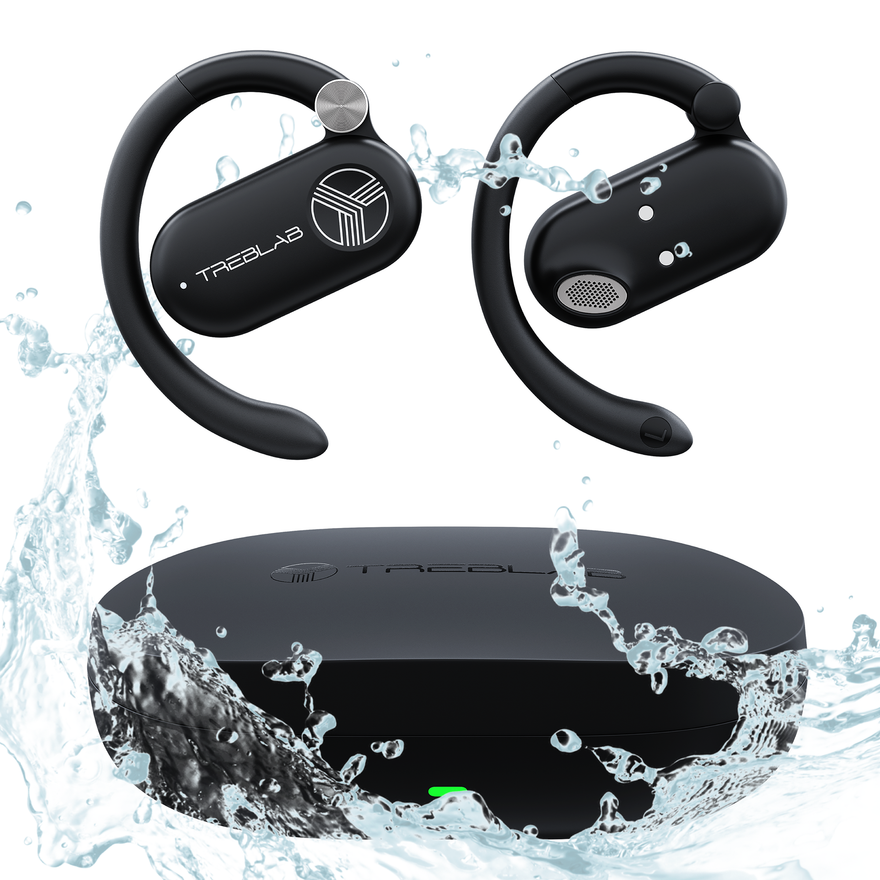
TREBLAB X-Open
Loudest Bluetooth Earbuds
Compact Charging Case for Extended Playtime
The sleek charging case provides an additional 30 hours of power, making it easy to carry and ensuring your loudest wireless earbuds are always ready for use.
Open-Ear Design for Awareness
The open-ear loudest earbuds on the market keep you aware of your surroundings while still enjoying high-quality audio, ideal for outdoor activities and safe workouts.
What Makes Earbuds Loud?

Loud earbuds depend on four connected elements: the driver, the amplifier, the seal inside your ear, and the manufacturer's tuning. A weak link in any of them limits the volume you can actually use, whatever the packaging promises.
Driver Size and Type
The driver is the miniature speaker inside each earbud, and its diaphragm moves air to create sound. A larger diaphragm moves more air with less strain, which improves bass and raises the maximum volume. Most models in this list with a published driver size fall between 8 and 11 millimeters. The TREBLAB X-Open uses a 14.2 mm driver and the CMF Buds 2a a 12.4 mm driver, both unusually large for this category. Hybrid designs such as the JBL Tour Pro 3 add a balanced armature for treble, so each unit operates in the frequency range it handles best.
Sensitivity, Impedance and the Built-In Amplifier
Sensitivity describes how loudly a driver plays from a fixed amount of electrical power, usually 1 milliwatt, so a higher number means more volume from the same battery drain. JBL rates the Tour Pro 3 at 104 decibels per milliwatt, and few flagship manufacturers publish this figure at all. Impedance works in the opposite direction, since lower values of 16 to 32 ohms let the amplifier deliver more current. Wireless earbuds carry their own amplifier and digital-to-analog converter, so your phone's audio output has no effect on the ceiling. Sony and Apple both highlight their amplifier designs in their current flagship models for this reason.
Seal, Fit and Noise Canceling
A sealed fit changes perceived volume more than any number on a specification sheet. When the ear tip closes the canal, bass stays inside and outside noise drops, so the same setting sounds noticeably louder. That explains why the loudest in ear headphones usually combine a deep seal with several tip sizes. Active noise cancelling adds a second layer of isolation by removing low rumble from engines and ventilation systems. Open-ear models deliberately skip the seal, trading some perceived loudness for the ability to hear traffic, cyclists and conversations around you.
Why Raw Decibels Tell Only Part of the Story
Two models with the same peak figure can sound very different near full volume. Weaker amplifiers add distortion at the top of the range, and harsh treble encourages people to turn the volume down early. Even the loudest earphones become tiring quickly if the high frequencies spike at maximum output. Manufacturers also measure output in different ways: sensitivity per milliwatt, maximum sound pressure, or a single number with no stated method. Our comparison table lists each figure with its basis and marks missing ones as not disclosed. In daily listening, clean sound at 70 to 80 percent volume matters more than the final few decibels.
Who Needs Loud Earbuds
Commuters on subways and buses face constant low-frequency noise that masks bass and vocals. Gym users compete with loudspeakers, dropped weights and ventilation fans, all of which mask quieter passages in a song. Runners and cyclists on city streets need enough volume to stay motivated while still hearing approaching cars, which favors open-ear designs or transparency modes. People with mild hearing loss may also want additional headroom, though an audiologist should guide that decision. If your routine matches one of these patterns, the loudest ear buds below will give you more usable range than a basic pair.
Loudest Wireless Earbuds Compared

The table compares all ten picks on the specifications that decide how loud wireless earbuds get in everyday use. Prices are manufacturer list prices at the time of writing, and street prices are often lower.
|
Earbud Model |
Fit Type |
Driver |
Published Output Rating |
Noise Control |
Battery (Buds / With Case) |
Water Resistance |
Price |
|
Beats Powerbeats Pro 2 |
In-ear, earhook |
n/d |
n/d |
Adaptive noise cancelling |
10 h / 45 h |
IPX4 |
$249.99 |
|
TREBLAB X-Open |
Open-ear, earhook |
14.2 mm dynamic |
124 dB (basis not stated) |
None (open design) |
9 h / 40 h |
IPX5 |
$49.97 |
|
JBL Tour Pro 3 |
In-ear, stem |
10.2 mm dynamic + balanced armature |
104 dB sensitivity (1 kHz, 1 mW) |
Adaptive noise cancelling |
11 h / 44 h |
IP55 |
$299.95 |
|
Sony WF-1000XM6 |
In-ear |
8.4 mm dynamic |
n/d |
Adaptive noise cancelling |
8 h / 24 h* |
IPX4 |
$329.99 |
|
Bose QuietComfort Ultra Earbuds (2nd Gen) |
In-ear, stability band |
n/d |
n/d |
Adjustable noise cancelling |
6 h / 24 h* |
IPX4 |
$299 |
|
Apple AirPods Pro 3 |
In-ear, stem |
n/d |
n/d |
Adaptive noise cancelling |
8 h / 24 h* |
IP57 |
$249 |
|
Soundcore Liberty 5 |
In-ear, stem |
9.2 mm dynamic |
n/d |
Adaptive noise cancelling |
12 h / 48 h |
IP55 |
$129.99 |
|
Audio-Technica ATH-CKS50TW2 |
In-ear |
9 mm dynamic |
n/d |
Hybrid noise cancelling |
25 h / 65 h |
IP55 |
$149 |
|
CMF Buds 2a |
In-ear, stem |
12.4 mm dynamic |
n/d |
Hybrid noise cancelling |
8 h / 35.5 h |
IP54 |
$29 |
|
JLab Go Air Sport |
In-ear, earhook |
6 mm dynamic |
103 dB max sound pressure |
None |
8 h / 32 h |
IP55 |
$29.99 |
The 10 Loudest Earbuds
This top 10 loudest earbuds list covers the loudest true wireless earbuds at flagship, midrange, and budget prices. Each model leads on at least one factor that increases usable volume, such as seal quality, driver size, noise-canceling, or battery endurance at high output. The ranking reflects suitability for loud listening, and every review weighs price separately.
Beats Powerbeats Pro 2 - Best Overall Loudest Earbuds

Rating:
⭐⭐⭐⭐⭐
The Powerbeats Pro 2 combine a sealed in-ear fit with nickel-titanium earhooks that keep each earbud in position during sprints and heavy lifts. Apple's H2 chip runs adaptive noise cancelling, Adaptive EQ and a heart-rate sensor in each earbud. The bass-forward Beats tuning keeps kick drums full at high volume, and physical volume rockers on both sides let you adjust without reaching for your phone.
Detailed Specifications:
- Fit Type: In-ear with nickel-titanium earhooks
- Driver: N/A (size not disclosed)
- Published Output Rating: N/A (not disclosed)
- Noise Control: Adaptive noise cancelling, transparency mode
- Battery (Buds / With Case): 10 h / 45 h with cancelling off; 8 h per charge with it on
- Water Resistance: IPX4
- Bluetooth: 5.3
- Codecs: SBC, AAC
- Wireless Charging Case: Yes (Qi)
+ Pros:
- Earhooks hold through hard training
- Noise cancelling lifts perceived volume
- Volume rockers on both buds
- 45 h total battery with case
- Heart-rate sensor in each bud
- One-tap pairing with Apple devices
- Cons:
- $249.99, five times the X-Open
- IPX4 trails IP55 rivals
- Bulky case for tight pockets
- No high-resolution codec
- Full features need an iPhone
Why it's our choice for loud listening:
The sealed fit and adaptive noise cancelling let the Powerbeats Pro 2 sound louder in a noisy gym than models with bigger published numbers. The earhooks keep that seal steady during movement, so the volume holds when you sprint or lift.
TREBLAB X-Open - Best Value Loud Earbuds

Rating:
⭐⭐⭐⭐⭐
The X-Open pairs a 14.2 mm composite dynamic driver with an open-ear earhook design that rests outside the ear canal. TREBLAB rates the driver at 124 dB, although the listing does not explain how that figure was measured. You get 9 hours per charge, 40 hours with the wireless charging case, IPX5 sweat protection and Bluetooth 5.4 with a 33-foot range.
Detailed Specifications:
- Fit Type: Open-ear with adjustable earhooks
- Driver: 14.2 mm composite dynamic
- Published Output Rating: 124 dB (measurement basis not stated)
- Noise Control: None for music (open design); dual-mic noise reduction for calls
- Battery (Buds / With Case): 9 h / 40 h
- Water Resistance: IPX5
- Bluetooth: 5.4
- Codecs: N/A (not disclosed)
- Wireless Charging Case: Yes (5 W)
+ Pros:
- Largest published driver in this list
- Hear traffic while you listen
- IPX5, above the Powerbeats' IPX4
- 40 h total battery with case
- Wireless charging at $49.97
- Earhooks stay put on runs
- Bluetooth 5.4 with 33 ft range
- Cons:
- Leaks sound in quiet rooms
- No noise cancelling for transit
- Less bass than sealed buds
- Codec support not published
Why it's our choice for loud listening:
The X-Open delivers the largest published driver in this ranking for $49.97, one fifth of the Powerbeats price. It suits loud listening outdoors, where hearing cars and cyclists matters as much as volume, although a sealed pair will sound louder in a packed subway car.
JBL Tour Pro 3

Rating:
⭐⭐⭐⭐
JBL's flagship uses a hybrid driver in each earbud, combining a 10.2 mm dynamic unit for bass with a balanced armature for treble. JBL publishes 104 dB sensitivity per milliwatt, an unusual disclosure among flagships, which places this model at the top of the loudest JBL earbuds. The touchscreen case controls playback and noise cancelling, and it can transmit audio from an airplane's headphone jack.
Detailed Specifications:
- Fit Type: In-ear with stem
- Driver: 10.2 mm dynamic + 5.1 x 2.8 mm balanced armature
- Published Output Rating: 104 dB sensitivity (1 kHz, 1 mW)
- Noise Control: True Adaptive noise cancelling 2.0
- Battery (Buds / With Case): 11 h / 44 h with cancelling off
- Water Resistance: IP55
- Bluetooth: 5.3
- Codecs: SBC, AAC, LDAC, LC3
- Wireless Charging Case: Yes
+ Pros:
- 104 dB published sensitivity
- Dual drivers keep treble clean
- LDAC for high-resolution streams
- IP55 dust and water rating
- Touchscreen case with audio transmitter
- 44 h total battery
- Cons:
- $299.95 list price
- Bulky case for small pockets
- LDAC cuts battery to 8.5 h
- Touch controls take practice
Why it's our choice for loud listening:
The Tour Pro 3 supports its volume with a published sensitivity figure, and the dual drivers keep vocals clear when you raise the level. Strong adaptive noise cancelling adds perceived loudness on flights, trains and busy city streets.
Sony WF-1000XM6

Rating:
⭐⭐⭐⭐
Sony's 2026 flagship keeps an 8.4 mm driver but adds a split-material diaphragm, 32-bit processing and an enhanced digital-to-analog amplifier. The QN3e processor and eight microphones run the noise cancelling, which sharply reduces steady train and engine noise. With that background removed, music sounds louder at a lower setting, and LDAC support preserves detail on compatible Android phones.
Detailed Specifications:
- Fit Type: In-ear with noise isolation tips
- Driver: 8.4 mm dynamic
- Published Output Rating: N/A (not disclosed)
- Noise Control: Adaptive noise cancelling, QN3e processor, 8 microphones
- Battery (Buds / With Case): 8 h / 24 h with cancelling on; 12 h per charge with it off
- Water Resistance: IPX4
- Bluetooth: 5.3
- Codecs: SBC, AAC, LDAC, LC3
- Wireless Charging Case: Yes (Qi)
+ Pros:
- Class-leading noise cancelling
- LDAC and LC3 support
- Enhanced DAC amplifier
- 10-band equalizer in the app
- Qi wireless charging
- 12 h per charge, cancelling off
- Cons:
- $329.99, priciest in this list
- 8.4 mm driver, modest size
- IPX4 splash rating only
- No published output figure
Why it's our choice for loud listening:
The XM6 removes so much background noise that music sounds louder at the same setting. The enhanced amplifier keeps detail steady near maximum volume, which suits long international flights and daily train commutes.
Bose QuietComfort Ultra Earbuds (2nd Gen)

Rating:
⭐⭐⭐⭐
Bose's second-generation Ultra Earbuds keep the stability-band fit and add a wireless charging case, AI-assisted call clarity and a Cinema mode. Noise cancelling remains among the strongest available in any earbud, and the punchy default tuning keeps drums and bass full. Immersive Audio widens the soundstage, although it reduces battery life from 6 to 4 hours per charge.
Detailed Specifications:
- Fit Type: In-ear with stability bands
- Driver: N/A (not disclosed)
- Published Output Rating: N/A (not disclosed)
- Noise Control: Adjustable noise cancelling, Aware mode
- Battery (Buds / With Case): 6 h / 24 h with Immersive Audio off
- Water Resistance: IPX4
- Bluetooth: 5.3
- Codecs: SBC, AAC, aptX Adaptive
- Wireless Charging Case: Yes
+ Pros:
- Top-tier noise cancelling
- Stable fit with three band sizes
- aptX Adaptive on Android
- Punchy, full default tuning
- Wireless charging case added
- Clear calls with AI filtering
- Cons:
- 6 h per charge, shortest here
- Immersive Audio: 4 h per charge
- Only three ear tip sizes
- $299 list price
Why it's our choice for loud listening:
Bose's noise cancelling strips out the constant rumble that pushes people to raise the volume. That makes the QC Ultra 2nd Gen feel loud and clean on buses and airplanes at moderate, more comfortable settings.
Apple AirPods Pro 3

Rating:
⭐⭐⭐⭐
AirPods Pro 3 pair a custom high-excursion driver with a high dynamic range amplifier, controlled by Apple's H2 chip. Five tip sizes, including a new XXS option, help more listeners achieve a complete seal, and the IP57 rating covers dust and water exposure during workouts. Android owners searching for the best alternative to AirPods will get more value from the Powerbeats Pro 2 or the X-Open.
Detailed Specifications:
- Fit Type: In-ear with stem
- Driver: Custom high-excursion driver, size N/A
- Published Output Rating: N/A (not disclosed)
- Noise Control: Active noise cancelling, Adaptive Audio, transparency mode
- Battery (Buds / With Case): 8 h / 24 h with cancelling on
- Water Resistance: IP57
- Bluetooth: 5.3
- Codecs: AAC, SBC
- Wireless Charging Case: Yes (MagSafe, Qi, Apple Watch charger)
+ Pros:
- IP57, highest rating in this list
- Five tip sizes, including XXS
- Loud Sound Reduction for hearing
- Heart-rate sensing for workouts
- Strong noise cancelling from H2
- Charges on MagSafe or Qi
- Cons:
- No published driver or output data
- AAC only, no LDAC
- Best features need an iPhone
- Shorter battery than Liberty 5
Why it's our choice for loud listening:
AirPods Pro 3 generate their usable volume through seal quality and noise cancelling more than raw output. The IP57 rating and five tip sizes suit iPhone users who want one pair for commuting, workouts and everyday listening.
Soundcore Liberty 5

Rating:
⭐⭐⭐⭐
The Liberty 5 uses 9.2 mm wool-paper drivers with dual bass tubes, which push low frequencies harder than most earbuds at this price. Adaptive noise cancelling 3.0 recalibrates every 0.3 seconds, and LDAC handles high-resolution files on Android. Battery life reaches 12 hours per charge with cancelling off, and the IP55 rating covers sweat, rain and dust.
Detailed Specifications:
- Fit Type: In-ear with stem
- Driver: 9.2 mm wool-paper dynamic with bass tubes
- Published Output Rating: N/A (not disclosed)
- Noise Control: Adaptive noise cancelling 3.0
- Battery (Buds / With Case): 12 h / 48 h with cancelling off; 8 h / 32 h with it on
- Water Resistance: IP55
- Bluetooth: 5.4
- Codecs: SBC, AAC, LDAC
- Wireless Charging Case: Yes (Qi)
+ Pros:
- Bass tubes add low-end punch
- 12 h per charge
- LDAC at $129.99
- IP55 dust and water rating
- Qi wireless charging
- Six ear tip sizes
- Cons:
- Squeeze controls feel fiddly at first
- Noise cancelling trails Sony and Bose
- No published output figure
- Dolby mode: 5 h per charge
Why it's our choice for loud listening:
The Liberty 5 ranks among the strongest loud earbuds with bass under $150, combining deep low end and long battery at roughly half a flagship's price. LDAC and IP55 protection make it a practical middle option for commuters who stream at high volume.
Audio-Technica ATH-CKS50TW2

Rating:
⭐⭐⭐⭐
Audio-Technica designed its Solid Bass line for listeners who want weight in the low end, and the CKS50TW2 delivers that tuning through exclusive 9 mm drivers. That makes it one of the best earbuds for loud music with heavy bass. Battery life reaches 25 hours per charge with noise cancelling off and 65 hours with the case, and a magnetic switch turns the earbuds off when you join them.
Detailed Specifications:
- Fit Type: In-ear
- Driver: 9 mm dynamic
- Published Output Rating: N/A (not disclosed)
- Noise Control: Hybrid noise cancelling, hear-through, talk-through
- Battery (Buds / With Case): 25 h / 65 h with cancelling off; 15 h / 40 h with it on
- Water Resistance: IP55
- Bluetooth: 5.3
- Codecs: SBC, AAC, LC3
- Wireless Charging Case: Yes (Qi)
+ Pros:
- 25 h per charge, longest here
- 65 h total with case
- Bass-heavy Solid Bass tuning
- Magnetic on-off switch
- IP55 dust and water rating
- Multipoint pairing support
- Cons:
- No LDAC or aptX
- No published output figure
- Bass-first tuning, less neutral
- Cancelling on: 15 h per charge
Why it's our choice for loud listening:
For listeners who want the loudest earbuds with bass and battery to spare, the CKS50TW2 covers a full week of commuting between charges. Its sealed fit and hybrid noise cancelling keep that bass audible in heavy traffic.
CMF Buds 2a

Rating:
⭐⭐⭐
The Buds 2a carry the largest driver of any model here under $30, using 12.4 mm bio-fibre units tuned by Dirac with Ultra Bass 2.0. Hybrid noise cancelling is rated at up to 42 dB, and four microphones handle calls. Battery life reaches 8 hours per charge with cancelling off and 35.5 hours with the case, although codecs stop at AAC and SBC.
Detailed Specifications:
- Fit Type: In-ear with stem
- Driver: 12.4 mm bio-fibre dynamic
- Published Output Rating: N/A (not disclosed)
- Noise Control: Hybrid noise cancelling (up to 42 dB), transparency mode
- Battery (Buds / With Case): 8 h / 35.5 h with cancelling off; 5 h / 23 h with it on
- Water Resistance: IP54
- Bluetooth: 5.4
- Codecs: SBC, AAC
- Wireless Charging Case: No
+ Pros:
- 12.4 mm driver for about $29
- Up to 42 dB noise cancelling
- Ultra Bass 2.0 tuning
- Bluetooth 5.4 with multipoint
- 10-minute charge for 5.5 h
- Cons:
- No wireless charging
- 5 h per charge, cancelling on
- IP54, below IP55 rivals
- No high-resolution codecs
- Case rated only IPX2
Why it's our choice for loud listening:
The Buds 2a bring a 12.4 mm driver and noise cancelling to the lowest price tier in this ranking. They make sense as a backup pair or for students who want real volume without spending $100.
JLab Go Air Sport

Rating:
⭐⭐⭐
JLab publishes a 103 dB maximum output for the Go Air Sport, an uncommon disclosure in the budget category, from 6 mm drivers and a sealed earhook fit. Three built-in sound presets, including Bass Boost, switch with a tap and require no app. You get 8 hours per charge, 32 hours with the case and an IP55 rating for sweaty workouts, all for $29.99.
Detailed Specifications:
- Fit Type: In-ear with earhooks
- Driver: 6 mm dynamic
- Published Output Rating: 103 dB maximum sound pressure level
- Noise Control: None (passive seal)
- Battery (Buds / With Case): 8 h / 32 h
- Water Resistance: IP55
- Bluetooth: 5.1
- Codecs: SBC
- Wireless Charging Case: No
+ Pros:
- Published 103 dB maximum output
- Costs $29.99 at list price
- Earhooks for secure workouts
- IP55 sweat and dust rating
- Bass Boost preset without an app
- Either bud works alone
- Cons:
- Small 6 mm drivers
- No noise cancelling
- Bluetooth 5.1 and SBC only
- Built-in cable, no wireless charging
- 2022 design, oldest in this list
Why it's our choice for loud listening:
The Go Air Sport shows that a loud, secure pair can cost under $30. Its published 103 dB ceiling and earhook seal suit gym sessions, although the X-Open adds a larger driver and newer Bluetooth for $20 more.
How to Choose the Loudest Bluetooth Earbuds

Fit decides more of your usable volume than any single specification when you shop for loud Bluetooth earbuds. Start with the choice between a sealed in-ear design and an open-ear one, then compare driver size, noise cancelling, battery, water resistance and codecs against your usual listening places.
Sealed In-Ear or Open-Ear
Sealed in-ear earbuds block outside sound and hold bass inside the ear canal, so they sound louder on trains and in gyms. Open-ear earbuds leave the canal free, which keeps you aware of cars, cyclists and people on the street. If most of your listening happens outdoors while you move, the X-Open fits that requirement well. Buyers who want TREBLAB's value with a closed fit can look at the TREBLAB X3-PRO, which uses a sealed earhook design. For long flights and loud public transport, a sealed pair with noise cancelling performs better.
Driver Size and Published Output
Larger drivers help, yet only a few manufacturers publish driver size or output, and their measurement methods differ. Treat 10 millimeters and above as a sign of volume headroom, and read each output figure with its measurement basis in mind. Loud earphones with small drivers can still reach high levels when sensitivity is strong, as the 6 mm JLab demonstrates. When a brand publishes nothing, independent lab reviews that test distortion at high volume become the most reliable guide.
Noise Cancelling for Transit
Noise cancelling reduces low-frequency rumble from engines, trains and ventilation systems, which lets music sound louder at the same setting. Among the models we checked, the Sony WF-1000XM6 and Bose QC Ultra 2nd Gen lead in this area. Budget cancelling, such as the 42 dB rating on the CMF Buds 2a, still makes a noticeable difference on buses. Open-ear designs cannot cancel noise, so they work better on quiet streets and in parks than on subways.
Battery Life at High Volume
High volume earbuds drain their batteries faster than rated figures suggest, because manufacturers often test at moderate levels. Apple, for example, rates AirPods Pro 3 battery life at 50 percent volume with noise cancelling enabled. Choose a pair with at least 8 hours per charge if you listen loudly through a full workday. The Audio-Technica ATH-CKS50TW2 leads this list with 25 hours per charge, and the Soundcore Liberty 5 follows with 12 hours.
Water Resistance for Outdoor Use
Sweat and rain are the main threats to earbuds used for running and cycling. IPX4 covers splashes, IPX5 adds protection against low-pressure water jets, and IP55 or IP57 ratings also block dust. The IPX5 rating on the X-Open exceeds the IPX4 found on the Powerbeats Pro 2, Sony WF-1000XM6 and Bose QC Ultra 2nd Gen. AirPods Pro 3 carry IP57, the highest rating in this comparison.
Codec Support
Codecs determine how much audio data reaches your ears over Bluetooth. AAC works well with iPhones, while LDAC and aptX Adaptive carry more detail on compatible Android phones, keeping cymbals and vocals cleaner at higher volume. LDAC does increase power consumption, and the JBL Tour Pro 3 drops from 11 to 8.5 hours per charge when you enable it.
Your budget determines the rest of the decision. Under $50, the X-Open, CMF Buds 2a and JLab Go Air Sport cover most needs. Shoppers comparing the loudest earbuds on Amazon in this price band will find all three listed there. Between $129 and $149, the Soundcore Liberty 5 and Audio-Technica ATH-CKS50TW2 add noise cancelling plus LDAC or exceptional battery life. Flagships from $249 to $329.99 bring the strongest noise cancelling available. The X-Open costs $49.97, one fifth of the Powerbeats Pro 2 price. It still offers a 14.2 mm driver, IPX5 against IPX4, Bluetooth 5.4 against 5.3 and 40 hours of total battery against 45.
How Loud Is Too Loud? Safe Listening Limits

Loud ear buds remain safe when volume and listening time stay within established limits. Noise damage to hearing accumulates gradually and does not heal, so the numbers below matter more as your earbuds get louder.
Safe Listening Time by Volume
The National Institute for Occupational Safety and Health in the United States sets 85 dBA as the workplace limit for an 8-hour day. Every 3 decibels above that level halves the safe time, so 88 dBA allows 4 hours, 94 dBA allows 1 hour and 100 dBA allows only 15 minutes. The same halving rule is widely used to estimate safe listening time on personal audio. For those devices, the World Health Organization and the International Telecommunication Union recommend a weekly budget of 80 dBA for 40 hours. That budget drops to 75 dBA for children and other sensitive listeners.
Warning Signs of Overexposure
Ringing or buzzing after a listening session, known as tinnitus, is often the first warning sign. Muffled hearing that lasts for hours, or difficulty following conversation in a noisy room, points in the same direction. Lower the volume and rest your ears immediately if you notice either symptom. If the symptoms do not fade within a day or two, or keep returning, book a hearing test with an audiologist.
Volume Limits and Hearing Features
iPhones and many Android phones include a headphone volume limit in their sound settings. AirPods Pro 3 add Loud Sound Reduction, which reduces sudden loud sounds in your environment. Many audiologists also recommend the 60/60 rule, which means no more than 60 percent volume for 60 minutes at a time. Noise cancelling supports all of these habits, because a quieter background lets you hear detail at a lower setting.
FAQ
What are the loudest earbuds on the market?
Who makes the loudest earbuds depends on how you measure volume. Among the models we checked, TREBLAB lists 124 dB for the X-Open without stating a method, and JBL publishes 104 dB sensitivity for the Tour Pro 3. JLab lists a 103 dB maximum for the Go Air Sport. The Powerbeats Pro 2 and Bose QC Ultra 2nd Gen often feel loudest in real noise, thanks to their seal and noise cancelling. Loudest wired earbuds can go higher with a separate amplifier, whereas wireless models set their own ceiling.
Can loud earbuds damage your hearing?
Loud earbuds can damage hearing when volume and listening time accumulate. Long sessions above 85 dBA gradually destroy the hair cells of the inner ear, and that loss is permanent. At 100 dBA, the NIOSH calculation allows only about 15 minutes per day, so volume limits, regular breaks and noise cancelling all reduce the risk.
Are earbuds loud enough for outdoor use?
Most current earbuds are loud enough for streets, parks and trails, although wind and traffic mask bass frequencies first. Sealed pairs keep more volume inside the ear, while open-ear pairs like the X-Open let you hear approaching cars and cyclists. On busy roads, prioritize awareness over maximum volume and keep the level moderate.
Why are my earbuds not loud enough?
A poor seal causes most low-volume complaints, so try a larger ear tip first. Earwax on the protective mesh can block sound, and a soft dry brush removes it safely. Check your phone's headphone volume limit and the companion app's equalizer, then install any available firmware update.
Does noise cancelling make earbuds sound louder?
Noise cancelling leaves the maximum output unchanged, yet it removes the engine and fan noise that competes with your music, so the same setting sounds louder. Among the loudest noise cancelling earbuds for perceived volume, the Sony WF-1000XM6 and Bose QC Ultra 2nd Gen let you keep the level lower on trains and airplanes.
What is the best alternative to AirPods for loud listening?
The Beats Powerbeats Pro 2 use the same Apple H2 chip, add earhooks and last 45 hours with the case. On a tighter budget, the TREBLAB X-Open costs $49.97 and brings a 14.2 mm driver with an open-ear fit. Android users who stream high-resolution files should look at the Soundcore Liberty 5 with LDAC.
Conclusion
The Beats Powerbeats Pro 2 lead this ranking for three reasons. Their sealed earhook fit holds under hard movement, adaptive noise cancelling raises perceived volume, and the case extends total battery to 45 hours. The TREBLAB X-Open takes the value position at $49.97, a $200 saving against the Powerbeats. It matches or beats them on several specifications, with a 14.2 mm driver, IPX5 against IPX4, Bluetooth 5.4 against 5.3 and 40 hours of total battery against 45. Its open design suits outdoor listening, while the Powerbeats perform better in loud public transport.
For flights and trains, the Sony WF-1000XM6 and Bose QC Ultra 2nd Gen offer the strongest noise cancelling in this comparison. The JBL Tour Pro 3 suits buyers who want a published 104 dB sensitivity figure together with LDAC. iPhone users get the most from AirPods Pro 3, and Android users with a moderate budget can choose the Soundcore Liberty 5. The Audio-Technica ATH-CKS50TW2 fits long days with 65 hours of battery, while the CMF Buds 2a and JLab Go Air Sport cover loud listening for about $30. The best loud earbuds for you depend on where you listen, so choose by setting first, then by volume, and keep weekly listening inside safe limits.


