

A jobsite speaker has to keep playing while concrete dust settles on it, while it takes a knock off a sawhorse, and while nobody has a free outlet for eight hours. We ranked ten models on the parameters that determine that outcome: ingress protection rating against dust and water, sustained RMS output, battery runtime per charge or per pack, power source (tool-platform battery versus built-in rechargeable), impact protection, phone-charging capability, weight, and price. Every spec below comes from manufacturer documentation or hands-on reviews, not from marketing copy.
Best
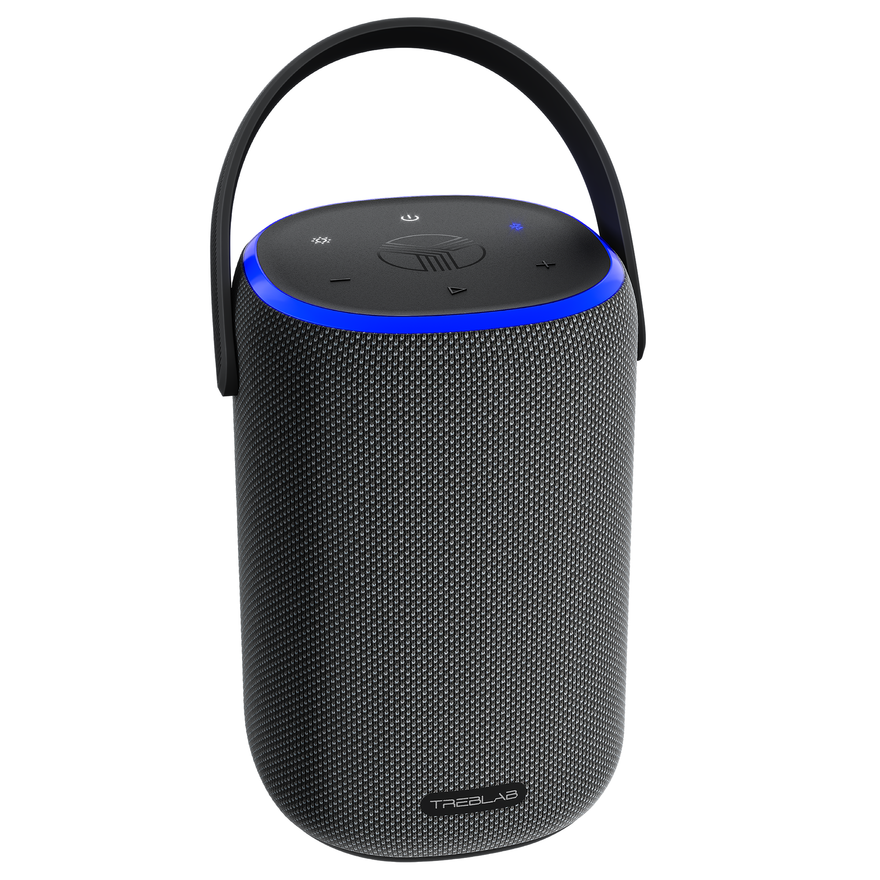
TREBLAB HD-Energy Pro
Best Outdoor Alexa Speaker
Made For Outdoor Sports And Adventures
Don’t be fooled by the gorgeous looks and cool ambient LED’s of this waterproof Alexa outdoor speaker. It is super rugged for all your outdoor sports, hiking, and getting active.
All Day Power On a Single Charge
The best outdoor speaker with Alexa, Treblab HD-Energy Pro, doesn’t play games with PlayXTend energy-saving tech and a high-capacity 5200mAh battery for you up to 18 hours of medium volume play per charge.
What Makes a Bluetooth Speaker Jobsite-Ready?

A jobsite-ready speaker survives three things a consumer speaker is never asked to survive: airborne abrasive dust, repeated drops onto hard surfaces, and a full shift away from mains power.
Tool brands and the trade press rank those the same way. Dust protection first, impact protection second, runtime third. Volume, which most shoppers check first, sits fourth.
Ingress Protection
The IP code has two digits: the first rates solid particles on a 0-6 scale, and the second rates liquid on a 0-9 scale. IP54 means dust-protected: some dust can enter, but it must not interfere with operation. IP65, IP67, and IP68 are dust-tight. An X in the first position means the manufacturer never tested for dust, which is why IPX6 and IPX7 tell you about water and nothing about silica.
Gypsum dust from sanding and silica dust from concrete cutting are fine, abrasive, and electrostatically charged. They creep past the grille cloth, settle on the driver surrounds, and pack into the port tubes. A speaker rated IPX7 will shrug off a hose-down and still fail after a season in a cutting zone.
Power Source
Platform speakers accept a tool battery: Milwaukee M18 and M12, Makita LXT and CXT, DEWALT 20V MAX and FLEXVOLT, Bosch Professional 18V. Runtime is limited only by the number of packs you brought. The catch is that the pack playing music is not the pack that drives your impact driver, and the speaker normally ships bare.
Standalone speakers carry their own cell and charge over USB-C. Anyone on the crew can use one, and the purchase price is the full price. Most of the tool-brand units also accept mains power, making them permanent shop fixtures once temporary power is in place.
Output vs Perceived Loudness on an Active Site
Doubling amplifier power yields roughly 3 dB, a change most listeners perceive as slightly louder. A 90W speaker is nowhere near four times as loud as a 20W one.
Site noise runs 85 to 95 dB, and what cuts through it is mid-range clarity between 500 Hz and 4 kHz, where voices and guitar sit. Placement helps more than wattage: a speaker set in the corner of a framed room picks up several decibels of boundary reinforcement for free.
What Disqualifies a Speaker from Jobsite Use
Three patterns rule a model out before you compare anything else. Fabric grilles trap fine particulate against the driver and cannot be cleaned properly, whereas metal grilles and molded housings can be cleared with compressed air. Runtime under eight hours means the speaker dies at 2 p.m. and lives in the truck by week three. And no mounting option, whether magnet, hook, strap, or Systainer lid, leaves the speaker on the floor, where there is dust, water, and boots.
Jobsite Bluetooth Speaker Comparison Table

|
Model |
Power Source |
Rated Output |
Battery Life |
Ingress Rating |
Phone Charging |
Price |
|
JBL Xtreme 5 |
Standalone |
90W RMS on battery, 130W on AC |
24h, plus 4h Playtime Boost |
IP68 |
Yes, built-in power bank |
$300–400 |
|
TREBLAB HD-Energy Pro |
Standalone |
30W RMS, 40W peak |
18h |
IPX6 |
Yes, built-in power bank |
$79.97 |
|
Milwaukee 2951-20 |
Platform (M12) or AC |
Not published, full-range driver plus tweeter |
10h on M12 CP2.0 |
IP54 |
Yes, 2.1A USB-A |
$149 |
|
Makita DMR203 |
Platform (LXT/CXT) or AC |
10W practical on 18V |
Up to 32h on 18V 6.0Ah |
IP65 |
Yes, USB-A |
$179 |
|
Bosch GPB 18V-1 C |
Platform (18V/AMPShare) or USB-C PD |
11W |
Not published |
Not published |
Yes, USB-C at 3A |
$95 |
|
Sony SRS-XE300 |
Standalone |
20W RMS |
24h |
IP67 |
No |
$100 |
|
Tribit StormBox Blast |
Standalone |
90W, 140W peak |
30h |
IPX7 |
Yes, built-in power bank |
$200 |
|
Festool SYS3 BT20 M 137 TOPROCK |
Standalone or AC |
20W total, 4 drivers |
~10h at medium volume |
Not published |
Yes, USB-A at 5V/1A |
$270 |
|
DEWALT DCR010 |
Platform (12V/20V MAX/FLEXVOLT) or AC |
Not published |
8–10h on a 2.0Ah pack |
Not published |
Yes, USB-A |
$129 |
|
Klein Tools AEPJS3 |
Standalone |
8W |
20h |
IP54 |
Yes, USB-A and USB-C |
$80 |
The 10 Best Bluetooth Speakers for Jobsite, Reviewed
Every unit below was checked against manufacturer documentation, and any spec the maker does not publish is marked rather than estimated.
JBL Xtreme 5 - Best Premium Standalone Pick

Rating: ⭐⭐⭐⭐⭐
The only speaker here with full IP68 sealing, which puts it in a class above every tool-brand unit in terms of dust resistance. A single large woofer and two tweeters push 90W RMS on battery, and the USB-C port runs both ways, so it charges a phone while playing. The shoulder strap and floating hooks give you somewhere to hang it.
Detailed Specifications:
- Power Source: Standalone rechargeable, USB-C PD input
- Rated Output (RMS): 90W on battery, 130W on AC
- Drivers: 1 × 98 × 145 mm woofer, 2 × 20 mm tweeters
- Bluetooth Version: 6.0
- Battery Life: 24 h, plus 4 h with Playtime Boost
- Ingress Protection Rating: IP68
- Impact Protection: Rubberized housing, drop resistance claimed, no rating published
- Phone Charging (USB out): Yes, USB-C at 5V/3A
- Weight: 2.9 kg (6.38 lb)
- Aux / USB Playback: USB-C lossless audio input, no 3.5 mm aux
- Price: $300–400
+ Pros:
- IP68, dust-tight and submersible
- 90W RMS on battery power
- 28h total with Playtime Boost
- USB-C power bank output
- Strap and hooks for hanging
- 7-band EQ in the app
- Auracast pairing for two units
- Cons:
- Four times the price of comparable value picks
- 6.4 lb, heaviest standalone here except Tribit
- Fabric wrap traps fine dust on the surface
- No 3.5 mm aux input
- Ambient lighting drains runtime
Why it's our choice for the jobsite
IP68 is the highest ingress protection rating on this list, so silica and gypsum dust stay out of the driver chamber. That matters more than the wattage on concrete cutting and demolition work, where every other model in the group is only dust-protected at best.
TREBLAB HD-Energy Pro - Best Value for Jobsite Use

Rating: ⭐⭐⭐⭐⭐
Dual full-range drivers and two passive radiators produce 30W RMS, enough to carry across a framed floor without distorting. The sealed IPX6 enclosure handles rain and hose spray, the battery runs 18 hours, and the built-in power bank tops up a phone mid-shift. Two units pair in TWS stereo when one unit does not provide enough coverage.
Not rated for dust ingress; keep it out of concrete and drywall cutting zones.
Detailed Specifications:
- Power Source: Standalone rechargeable, USB-C input
- Rated Output (RMS): 30W RMS, 40W peak
- Drivers: 2 full-range drivers, 2 passive bass radiators
- Bluetooth Version: 5.0, 33 ft range
- Battery Life: 18 h
- Ingress Protection Rating: IPX6
- Impact Protection: Not published
- Phone Charging (USB out): Yes, built-in power bank
- Weight: Not published
- Aux / USB Playback: USB flash drive playback, no 3.5 mm aux
- Price: $79.97
+ Pros:
- 30W RMS at $79.97
- 18h runtime, covers a full shift
- Power bank output for phones
- IPX6 sealed against rain and spray
- TWS pairing for two-unit coverage
- Ergonomic carry handle
- USB-C charging, no proprietary cable
- Cons:
- No dust rating published
- No mounting magnet or hook
- Bluetooth 5.0, older than most rivals here
Why it's our choice for the jobsite:
It covers the three things that determine a jobsite purchase: runtime past a full shift, output that carries over to hand tools, and phone charging, at a price where losing one to a drop is an annoyance rather than a claim on the tool budget.
Milwaukee 2951-20

Rating: ⭐⭐⭐⭐
Milwaukee's current compact jobsite audio unit combines a Bluetooth speaker, an AM/FM tuner, and an M12 battery charger in one housing. A self-centering keyhole and a hollow handle mean it hangs from a nail, a stud, or a hook instead of sitting in the dust. IP54 sealing and a 10-foot drop test back the claim.
Detailed Specifications:
- Power Source: Platform (M12) or AC via included supply
- Rated Output (RMS): Not published
- Drivers: Full-range driver and tweeter
- Bluetooth Version: 4.2
- Battery Life: 10 h on an M12 CP2.0 pack
- Ingress Protection Rating: IP54
- Impact Protection: Impact-resistant exterior, 10 ft drop tested
- Phone Charging (USB out): Yes, USB-A at 2.1A
- Weight: Not published
- Aux / USB Playback: AM/FM radio built in, aux not published
- Price: $149
+ Pros:
- Charges M12 packs while playing
- IP54 dust and water rated
- 10 ft drop tested
- Keyhole and handle hanging options
- AM/FM alongside Bluetooth
- Compact 9.2 in. footprint
- Fits inside PACKOUT boxes
- Cons:
- Bluetooth 4.2, oldest radio in this group
- Output power never published
- 10h runtime only on the small CP2.0 pack
- Locked to the M12 platform
- Battery sold separately
Why it's our choice for the jobsite:
Hanging is the feature that keeps it alive. A speaker on a nail at chest height stays above the dust layer, avoids boots, and projects farther than the same unit on a slab; the M12 charging port means one fewer charger on the temporary power.
Makita DMR203

Rating: ⭐⭐⭐⭐
The longest runtime of any platform speaker here: 32 hours on an 18V 6.0Ah pack at low output. A 101.6 mm subwoofer, a 36 mm tweeter, and an 89 mm passive radiator sit behind protective bumpers, and the IP65 rating makes it dust-tight. Up to ten units link over TWS for coverage across a large floor.
Detailed Specifications:
- Power Source: Platform (12V CXT / 18V LXT) or AC adaptor
- Rated Output (RMS): 10W practical output on 18V
- Drivers: 101.6 mm subwoofer, 36 mm tweeter, 89 mm passive radiator
- Bluetooth Version: 5.0
- Battery Life: Up to 32 h on 18 V 6.0 Ah, 20 h on 4.0Ah
- Ingress Protection Rating: IP65
- Impact Protection: Protective bumpers on the housing
- Phone Charging (USB out): Yes, USB-A
- Weight: 2.7 kg (5.95 lb) without battery
- Aux / USB Playback: 3.5 mm aux input, MP3 compatible
- Price: $179
+ Pros:
- IP65, dust-tight enclosure
- Up to 32h on one pack
- Links up to 10 units
- Six EQ presets plus custom mode
- Runs on CXT and LXT packs
- Three-year Makita warranty
- LCD display for settings
- Cons:
- 10W practical output, quiet on open sites
- 5.95 lb before you add a battery
- Runtime figure measured at 100 mW output
- No AM/FM tuner
- Body-only purchase, battery extra
Why it's our choice for the jobsite:
IP65 keeps silica out entirely, which very few speakers in this price band manage. Pair that with a full working week of runtime on a single 6.0Ah pack, and it becomes the model you leave on site rather than carry home each evening.
Bosch GPB 18V-1 C

Rating: ⭐⭐⭐⭐
The lightest platform speaker in the group at 0.7 kg without a battery, built around a single 11W mid-range driver. Bluetooth 5.4 is the newest radio here. It accepts Bosch Professional 18V packs and any AMPShare battery, and it will also run straight off a USB-C power delivery supply.
No ingress protection rating is published; treat it as an indoor, light-duty unit.
Detailed Specifications:
- Power Source: Platform (Bosch 18V / AMPShare) or USB-C PD supply
- Rated Output (RMS): 11W nominal per mid-range speaker
- Drivers: 1 mid-range speaker, no subwoofer
- Bluetooth Version: 5.4
- Battery Life: Not published
- Ingress Protection Rating: Not published
- Impact Protection: No protective frame fitted
- Phone Charging (USB out): Yes, USB-C at up to 3A
- Weight: 0.7 kg (1.54 lb) without battery
- Aux / USB Playback: None
- Price: $95
+ Pros:
- 1.54 lb, lightest platform unit
- Bluetooth 5.4, newest radio here
- Runs on AMPShare batteries
- USB-C output at 3A
- Also runs on USB-C power supply
- Carrying strap included
- Multi-Speaker Sound linking
- Cons:
- No IP rating published at all
- No protective frame around the housing
- Single driver, 11W nominal
- Runtime never stated by Bosch
- No aux input or USB playback
- No charge level indicator
Why it's our choice for the jobsite:
It moves with you. At a pound and a half, it clips onto a bag for a service call or a panel job, and the 3A USB-C output charges a phone faster than most jobsite speakers manage. Sound coverage is limited to one room.
Sony SRS-XE300

Rating: ⭐⭐⭐⭐
Sony's line-shape diffuser spreads sound sideways rather than firing it forward, which suits an open floor better than a directional speaker of the same size. IP67 sealing covers dust and immersion, including salt water, and Sony shock-tests the housing. Runtime reaches 24 hours, and the whole unit weighs 1.3 kg.
Detailed Specifications:
- Power Source: Standalone rechargeable, USB-C input
- Rated Output (RMS): 20W per retailer listings, not stated by Sony
- Drivers: X-Balanced driver with dual passive radiators
- Bluetooth Version: 5.2, 98 ft range
- Battery Life: 24 h
- Ingress Protection Rating: IP67
- Impact Protection: Shock-tested by Sony, no numeric rating
- Phone Charging (USB out): No
- Weight: 1.3 kg (2.87 lb)
- Aux / USB Playback: None
- Price: $100
+ Pros:
- IP67 dust-tight and submersible
- 24 h on one charge
- 2.87 lb, easy one-hand carry
- Saltwater resistant
- Wide dispersion from the diffuser
- 10 min charge gives 70 min playback
- Links up to 100 units via app
- Cons:
- No phone charging output
- No aux input for older devices
- Modest output for open-air sites
- Fabric grille holds fine dust
- No mounting point, hook, or magnet
Why it's our choice for the jobsite:
IP67 at $100 is the best dust protection per dollar in this list. The wide dispersion pattern also means one unit covers a framed floor evenly, rather than being loud at one end, as is typical with most speakers of this size.
Tribit StormBox Blast

Rating: ⭐⭐⭐⭐
The loudest option here on paper: two 4.2-inch woofers and two 1.2-inch tweeters driven to 90W, with a 140W peak and a stated 110 dB maximum. Battery life runs for 30 hours, longer than anything else standalone, and the power bank output charges devices. It weighs 11.6 lb, which is a genuine two-hand carry.
Not rated for dust ingress; the IPX7 figure covers water only.
Detailed Specifications:
- Power Source: Standalone rechargeable
- Rated Output (RMS): 90W, 140W peak
- Drivers: 2 × 4.2 in. woofers, 2 × 1.2 in. tweeters
- Bluetooth Version: 5.3, 150 ft range
- Battery Life: 30 h
- Ingress Protection Rating: IPX7
- Impact Protection: ABS housing, no rating published
- Phone Charging (USB out): Yes, built-in power bank
- Weight: 5.45 kg (11.6 lb)
- Aux / USB Playback: 3.5 mm aux input
- Price: $200
+ Pros:
- 90W output, 110 dB claimed
- 30h runtime, longest standalone
- IPX7 handles full immersion
- Power bank output included
- Custom EQ in the Tribit app
- TWS pairing for stereo
- Fixed carry handle
- Cons:
- 11.6 lb, awkward to reposition
- No dust rating published
- LED light show has no jobsite use
- 4.5h to recharge fully
- Consumer styling, no impact rating
Why it's our choice for the jobsite:
Volume is its one argument, and it is a real one in exterior work, roofing, and open slabs where sound has nothing to reflect off of. Indoors, there are more speakers than the space needs, and the weight starts to matter every time the crew moves.
Festool SYS3 BT20 M 137 TOPROCK

Rating: ⭐⭐⭐⭐
A Bluetooth speaker built into a Systainer³ lid, so it stacks with the rest of a Festool stack and stores tools underneath. Four 50-mm neodymium drivers and two bass-reflex tubes total 20 watts. The internal battery runs about ten hours at medium volume, and a USB port charges devices.
No ingress protection rating published; the Systainer body is not certified against dust or water.
Detailed Specifications:
- Power Source: Standalone integrated 11V battery or AC supply
- Rated Output (RMS): 20W total
- Drivers: 4 × 50 mm neodymium, 2 bass reflex tubes
- Bluetooth Version: 5.0, 164 ft range
- Battery Life: ~10 h at medium volume
- Ingress Protection Rating: Not published
- Impact Protection: Systainer³ housing, no rating published
- Phone Charging (USB out): Yes, USB-A at 5V/1A
- Weight: 2.8 kg (6.17 lb)
- Aux / USB Playback: Not published
- Price: $270
+ Pros:
- Stacks with any Systainer generation
- Stores tools inside the case
- 164 ft Bluetooth range
- Flush illuminated lid controls
- TWS pairing for stereo
- Holds 11 lb stacked on top
- Runs on mains or battery
- Cons:
- No IP rating published
- 10h runtime, shortest standalone here
- 1A USB output charges phones slowly
- $270 for 20 watts
- Only worth it inside the Festool system
Why it's our choice for the jobsite:
The value is logistical. It rides in the van as part of the Systainer stack, takes up no extra space, and the lid stays accessible while stacked. Crews already running Festool storage get audio without carrying a separate box.
DEWALT DCR010

Rating: ⭐⭐⭐⭐
Dual 3-inch speakers and a bass reflex port in an impact-resistant housing with a metal grille. It runs on 12V MAX, 20V MAX, and FLEXVOLT packs or straight off mains, and the carry handle has a slot that holds a phone upright. Independent testing recorded 9 hours 15 minutes with a 2.0 Ah pack at 60% volume.
No ingress protection rating published; DEWALT states there is no IP rating for this model.
Detailed Specifications:
- Power Source: Platform (12V MAX / 20V MAX / FLEXVOLT) or AC cord
- Rated Output (RMS): Not published
- Drivers: 2 × 3 in. speakers with bass reflex port
- Bluetooth Version: Not published, 100 ft range
- Battery Life: 8–10 h on a 2.0Ah pack
- Ingress Protection Rating: Not published
- Impact Protection: Metal grille, impact-resistant housing
- Phone Charging (USB out): Yes, USB-A
- Weight: 1.8 kg (3.97 lb)
- Aux / USB Playback: 3.5 mm aux input
- Price: $129
+ Pros:
- Runs on three DEWALT battery lines
- Metal grille resists dust better than cloth
- Phone slot in the handle
- Mains cord included
- 3.97 lb, easy to move
- Three-year limited warranty
- Aux input for older devices
- Cons:
- No IP rating published
- Output power never stated
- Reviewers report weak maximum volume
- Bluetooth connection drops reported
- Cannot charge DEWALT packs
Why it's our choice for the jobsite:
If your van already runs DEWALT, this is the cheapest way to get audio without buying another battery ecosystem. The metal grille and molded housing clean up with compressed air, which matters more day-to-day than the missing IP rating suggests.
Klein Tools AEPJS3

Rating: ⭐⭐⭐⭐
Built around mounting rather than output. Embedded magnets stick it to a panel or a stud bracket, and an integrated hook hangs it from a nail. IP54 sealing and a 6.6-foot drop rating protect against abuse; the battery lasts 20 hours, and both USB-A and USB-C ports charge phones, headlamps, and fans.
Detailed Specifications:
- Power Source: Standalone rechargeable, USB-C input
- Rated Output (RMS): 8W
- Drivers: Full-range driver
- Bluetooth Version: 5.1, 100 ft range
- Battery Life: 20 h
- Ingress Protection Rating: IP54
- Impact Protection: 6.6 ft (2 m) drop protection
- Phone Charging (USB out): Yes, USB-A and USB-C
- Weight: Not published
- Aux / USB Playback: 3.5 mm aux input
- Price: $80
+ Pros:
- Magnets and hook for mounting
- IP54 dust- and water-rated
- 6.6 ft drop protection
- 20h runtime
- Two charging outputs
- Broadcast mode links five units
- Charges fully in three hours
- Cons:
- 8W, quietest model in this list
- Sound range limited to 180 Hz–13 kHz
- Rated 80 dB at 1 m, easily buried by machinery
- No weight figure published
- One driver, no stereo separation
Why it's our choice for the jobsite:
Electricians and anyone working from a ladder get the most out of it. The magnet holds it on the panel you are already standing at, so audio follows you between rooms, and the speaker never sits on the floor collecting dust and water.
How to Choose a Bluetooth Speaker for the Jobsite

Start with the ingress rating and let it eliminate most of the market before you compare anything else. Everything below assumes you have already applied that filter.
Start with the Ingress Rating
Match the first digit of the IP to your trade. Concrete cutting, demolition, and drywall sanding need a 6 in that position, which means IP65, IP67, or IP68. Framing, electrical rough-in, and finish carpentry are rated IP54, meaning dust can enter but does not affect the unit's operation. If the first digit is an X or the manufacturer does not publish an IP rating, the speaker is intended for indoor or shop use.
Match the Power Source to Your Tool Platform
Tool-platform speakers only make sense if you already own three or more packs of that brand. A single 5.0Ah battery tied up in a speaker for eight hours is a real cost on a day when the impact driver runs out of charge. Standalone units sidestep that entirely, charge from any USB-C source, and work for whoever picks them up. Mixed crews with three different tool brands on site almost always end up on a standalone speaker for that reason.
Runtime That Covers a Full Shift
Set the floor at ten hours and treat manufacturer figures with suspicion, because most are measured at low output. Makita quotes 32 hours on a 6.0Ah pack at 100 milliwatts, which is a fraction of listening volume. Independent testing of the DEWALT DCR010 produced 9 hours 15 minutes at 60% volume on a 2.0Ah pack, and that number is more useful than any spec sheet. Assume you will get roughly half of the quoted figure at working volume.
Impact Protection and Where You Set It Down
Published drop ratings are rare, so use them when available: Klein certifies 6.6 feet; Milwaukee tested the 2951-20 to 10 feet. Where no rating exists, look at the housing instead, because a metal grille and molded plastic survive what fabric wrap does not. Mounting matters as much as the drop rating. A speaker mounted on a magnet, hook, or strap at waist height avoids the dust layer, water, and boots, and projects farther than the same unit on a slab.
Output That Cuts Through Site Noise
Buy for the space, not for the number. An 8W to 20W unit covers a single room or a stairwell landing; 30W to 40W handles a framed floor; 90W is for exterior work and open slabs where sound has nothing to reflect off. Mid-range clarity between 500 Hz and 4 kHz is what survives compressor and saw noise, and it rarely appears on a spec sheet, so reviews are the better guide there.
FAQ
Are jobsite Bluetooth speakers worth it over a regular portable speaker?
They are if your work generates dust or your speaker lives on a floor. The difference is the enclosure and the mounting hardware, not the sound, and a consumer speaker with fabric wrap will fail in a cutting zone within a season. For clean interior work, the gap is narrow enough that a sealed consumer unit is a reasonable choice.
What ingress rating do I need for construction dust?
A first digit of 6, which means IP65 or better, keeps silica and gypsum completely out of the driver chamber. IP54 is dust-protected rather than dust-tight and works for framing, electrical, and finish trades. An IPX rating tells you about water and nothing about dust, because the manufacturer never ran the test.
Do I need a speaker that runs on my tool batteries?
Only if you already carry spare packs from that brand. Platform speakers offer unlimited runtime as long as you have batteries, but they lock you into one manufacturer and consume a pack you might need for tools. Standalone speakers charge via USB-C and work with any crew, regardless of what is in their van.
How loud does a jobsite speaker need to be?
Active sites run 85 to 95 dB, so a speaker needs to sit above that without distorting. Thirty watts RMS covers a framed floor at conversational listening levels, and 90W is only necessary outdoors. Doubling the wattage adds roughly 3 dB, which is why a 90W unit is nowhere near four times as loud as a 20W one.
Can a jobsite speaker charge my phone?
Most of them can. Eight of the ten models here have a USB output, ranging from Festool's 1A trickle to Bosch's 3A USB-C, and only the Sony SRS-XE300 has none. Speakers with large internal batteries, including the TREBLAB HD-Energy Pro and the JBL Xtreme 5, are marketed as power banks because they can recharge a phone more than once.
How long do the best Bluetooth speakers for jobsite last before they fail?
Two to five years, and dust ingress determines where a given unit falls within that range. Sealed IP65- to IP68-rated models last the longest because nothing abrasive reaches the driver surrounds or the port tubes. Fabric-wrapped speakers on dusty sites tend to lose treble first, then fail in the amplifier stage.
Conclusion
The TREBLAB HD-Energy Pro is the pick for most trades. It delivers 30W RMS, carries across a framed floor, offers 18 hours of runtime that outlasts the shift, and includes a built-in power bank that keeps a phone alive without a second device in the bag, all for $79.97. On sealing, it gives up ground to the tool-brand units, so treat it as a speaker for framing, electrical, finish work, and exterior jobs rather than for concrete cutting.
Three alternatives cover the cases it does not. The JBL Xtreme 5 is the only IP68 model here and the right answer where dust is constant and the budget allows $300 or more. The Makita DMR203 combines IP65 sealing with up to 32 hours of runtime on a single pack, making it suitable for crews already using LXT batteries. The Klein Tools AEPJS3 at $80 wins on mounting alone because its magnets and hook keep it off the ground, where nothing else on this list can go. The decision comes down to three questions, in order: how much dust, which batteries you already own, and how big the space is.


