


Most earbuds are designed for people in their 20s and 30s — sealed in-ear tips that cause discomfort after an hour, touch controls that require precise finger placement, and zero situational awareness that creates safety issues outdoors. This guide evaluates 10 earbuds specifically through the lens of senior use, scoring each on fit architecture (open vs. sealed), weight per unit, speech clarity, mid-range frequency clarity, environmental awareness, control simplicity, battery life, and price-to-value ratio.
Best
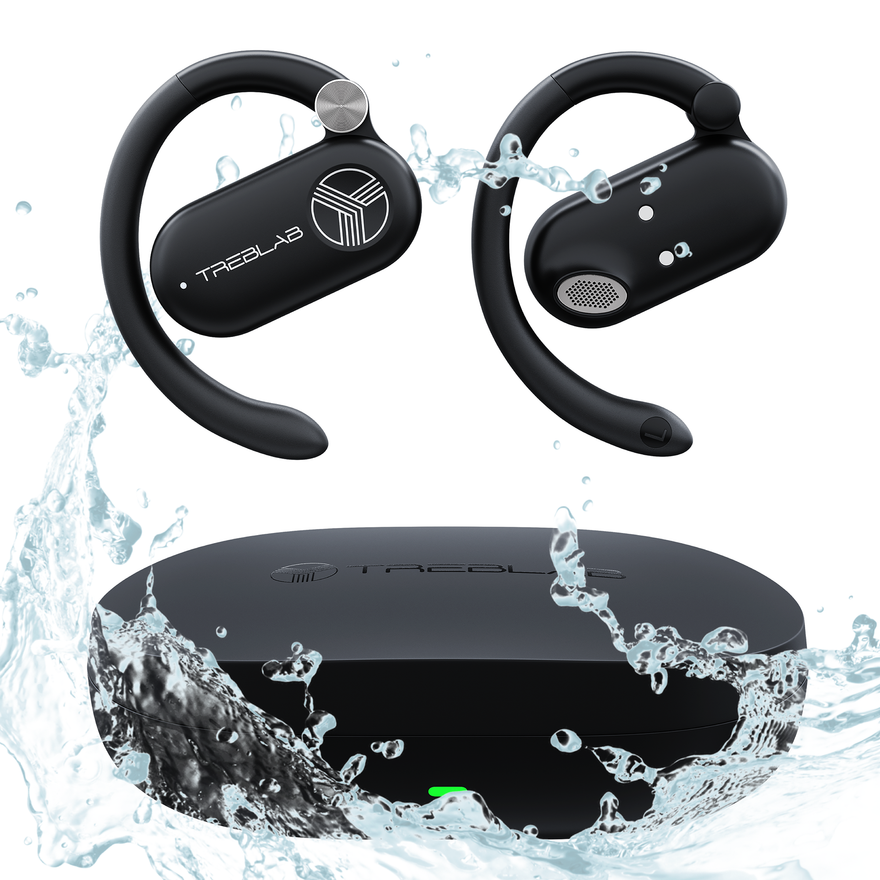
TREBLAB X-Open
Best Earbuds for Seniors
Compact Charging Case for Extended Playtime
The sleek charging case provides an additional 30 hours of power, making it easy to carry and ensuring your loudest wireless earbuds are always ready for use.
Open-Ear Design for Awareness
The open ear loudest earbuds on the market keep you aware of your surroundings while still enjoying high-quality audio, ideal for outdoor activities and safe workouts.
What Makes Earbuds Compatible with Senior Use?

Standard earbuds are optimized for noise isolation, which directly conflicts with two of the most common senior requirements: safety and physical comfort. As ears age, the ear canal becomes more sensitive to pressure and prolonged occlusion — the feeling of a sealed canal — which causes discomfort that worsens with extended wear. This is separate from hearing loss: even seniors with healthy hearing often find sealed in-ear buds fatiguing within 30–60 minutes.
The second factor is situational awareness. Seniors who walk, commute, or simply spend time outdoors need to hear traffic, conversations, doorbells, and alarms without having to remove their earbuds. Sealed ANC earbuds eliminate that entirely unless Transparency mode is active — adding a layer of complexity that not everyone wants to manage.
A third dimension is the control interface. Touch-sensitive surfaces are convenient for younger users but problematic for seniors with reduced fingertip sensitivity or early-stage dexterity changes. Physical buttons with tactile feedback are consistently rated higher for ease of use in this demographic.
Fit type compatibility for seniors

|
Fit Type |
Canal Contact |
Awareness |
Long-Wear Comfort |
Senior-Friendly |
|
Open-ear hook |
None |
Full, passive |
Excellent |
✅ Best |
|
Semi-open / ear-clip |
Minimal |
Good |
Good |
✅ Good |
|
In-ear (loose fit) |
Light |
Limited |
Moderate |
⚠️ Depends |
|
In-ear (sealed ANC) |
Sealed |
Blocked |
Poor for long wear |
⚠️ Use case specific |
|
In-ear OTC hearing aid |
Sealed |
App-controlled |
Moderate |
✅ Hearing loss use |
Open-ear designs - where the driver rests against the outer ear without entering the canal - represent the clearest structural fit for seniors who prioritize comfort and awareness. Sealed in-ear earbuds remain valid for specific contexts: focused listening, TV audio, or moderate hearing loss where amplification matters more than ambient sound.
Comparison of Best Earbuds for Seniors

|
Model |
Fit Type |
Ear Contact Zone |
Weight (per unit) |
Battery Life |
IPX Rating |
Price |
|
TREBLAB X-Open |
Open-ear hook |
External pinna only |
8.9g |
10h / 40h total |
IPX5 |
~$49 |
|
JLab Hear OTC |
In-ear OTC hearing aid |
Canal |
~7g |
12h / 35h total |
IPX4 |
~$99 |
|
Sony WF-1000XM6 |
In-ear sealed |
Canal |
~5g |
12h / 36h total |
IPX4 |
$299 |
|
Jabra Elite 8 Active Gen 2 |
In-ear sealed |
Canal |
~6g |
8h / 32h total |
IP68 |
$199 |
|
Anker Soundcore Liberty 4 Pro |
In-ear |
Canal |
~5.5g |
11h / 44h total |
IPX4 |
~$99 |
|
Technics EAH-AZ100 |
In-ear |
Canal |
~5.8g |
10h / 28h total |
IPX4 |
$249 |
|
Beats Powerbeats Pro 2 |
Ear-hook in-ear |
Canal + hook |
~9.6g |
10h / 45h total |
IPX4 |
$249 |
|
EarFun Air Pro 4 |
In-ear |
Canal |
~5g |
11h / 52h total |
IPX5 |
~$79 |
|
Nothing Ear (a) |
In-ear |
Canal |
~4.8g |
9.5h / 42h total |
IP54 |
$99 |
|
Denon PerL Pro |
In-ear |
Canal |
~7.5g |
10h / 40h total |
IPX4 |
$349 |
Legend — Fit types: "Open-ear hook" = no canal insertion, driver on outer ear; "In-ear OTC hearing aid" = sealed fit with active hearing amplification; "In-ear sealed" = standard ANC in-ear with full canal occlusion; "Ear-hook in-ear" = canal tip with stabilizing over-ear hook. Battery life format: earbuds only / total with case.
The 10 Best Earbuds for Seniors - Reviewed
The picks below span open-ear, hybrid hearing-aid, and sealed ANC designs, covering every senior use case, from daily outdoor walks to home listening, for those with mild hearing loss. Each model was evaluated on the criteria that matter most for seniors: fit comfort, ear canal impact, situational awareness options, control simplicity, sound clarity, and sustained battery life.
TREBLAB X-Open - Best Overall Earbuds for Seniors

Rating: ⭐⭐⭐⭐⭐
The TREBLAB X-Open rests against the outer ear on a behind-the-ear hook, with zero canal insertion. The 14.2mm driver delivers rich, full-range audio while leaving the ear canal completely unoccluded — no pressure, no seal, no buildup of discomfort over time. At 8.9g per earbud, they stay secure without adding any meaningful weight load to the outer ear.
Detailed Specifications:
- Fit Type: Open-ear hook (no canal insertion)
- Driver Size: 14.2mm dynamic
- Bluetooth Version: 5.4
- Battery Life (earbuds): 10 hours
- Battery Life (total with case): 40 hours
- Weight (per earbud): 8.9g (0.31 oz)
- Water Resistance: IPX5
- Microphone: Dual ENC mics
- Charging: USB-C + 5W Qi wireless charging
- Price: ~$49
+ Pros:
- Zero ear canal contact — no occlusion fatigue
- 14.2mm driver for rich, detailed audio without isolation
- 40h total battery — among the highest in class
- IPX5 + wireless charging at this price point
- Bluetooth 5.4 — latest standard, stable pairing
- Cons:
- Open-ear design means no passive noise isolation
- Single color option at launch (black)
Why it's our choice for seniors:
The X-Open eliminates the single most common complaint seniors have about earbuds: ear canal pressure. Full situational awareness is passive — no transparency mode to enable, no settings to manage. Seniors who walk, commute, or simply want to be reachable while listening get all of that without touching a button.
JLab Hear OTC Hearing Aid & Earbuds

Rating: ⭐⭐⭐⭐☆
The only FDA-registered OTC hearing aid on this list, the JLab Hear, functions as both a Bluetooth earbud and a clinical hearing amplifier. Four preset hearing modes — Loud Environment, Restaurant, Conversation, and Quiet — switch with a single tap, no app required. Independent volume control for left and right earbuds addresses one of the most common features sought by seniors with uneven hearing.
Not recommended for seniors without mild-to-moderate hearing loss — the hearing aid amplification is not beneficial for normal hearing.
Detailed Specifications:
- Fit Type: In-ear sealed
- Driver Size: 10mm dynamic
- Bluetooth Version: 5.3
- Battery Life (earbuds): 10h (hearing mode) / 7h (Bluetooth music mode)
- Battery Life (total with case): 40h (hearing mode)
- Weight (per earbud): ~5.2g
- Water Resistance: IPX4
- Microphone: Directional mics with feedback suppression
- Charging: Integrated USB-C cable in case
- Price: ~$99
+ Pros:
- FDA-registered OTC hearing aid at an accessible price
- Dual-mode: hearing aid only, or hearing aid + Bluetooth
- 4 environmental hearing presets, tap-switchable without app
- Independent L/R volume control
- In-ear detection auto-activates hearing aid mode
- Built-in feedback suppression
- Cons:
- Speech-in-noise performance below category average (per HearAdvisor testing)
- Limited hearing profile customization (preset-only, no frequency-specific adjustment)
- IPX4 — lower water resistance than workout-focused models
- Flimsy case reported by multiple reviewers
- SBC/AAC only — no high-res codec support
Why it's our choice for seniors
Seniors with mild-to-moderate hearing loss get a dual-purpose device for $99, while prescription equivalents cost $3,000–$6,000. The tap-based mode switching requires no app interaction or technical knowledge, making it genuinely accessible for daily use.
Sony WF-1000XM6

Rating: ⭐⭐⭐⭐☆
Sony's 2026 flagship earbuds are built around the QN3e processor — 3x faster than its predecessor — driving eight adaptive microphones that rework the noise-canceling profile in real time. The XM6 is tuned in collaboration with Grammy-nominated mastering engineers, resulting in what independent testers at SoundGuys have confirmed to be class-leading audio fidelity. The redesigned, matte-finish body is 11% slimmer than the XM5, reducing in-ear bulk for more comfortable extended wear.
Detailed Specifications:
- Fit Type: In-ear sealed
- Driver Size: 8.4mm dynamic (split-material diaphragm)
- Bluetooth Version: 5.3
- Battery Life (earbuds): 8 hours (ANC on)
- Battery Life (total with case): 24 hours
- Weight (per earbud): ~5g (estimated; Sony has not published the official earbud weight for XM6)
- Water Resistance: IPX4
- Microphone: 8 microphones, AI beamforming
- Charging: USB-C + Qi wireless charging
- Price: $329.99
+ Pros:
- Class-leading ANC with real-time environmental adaptation
- Studio-level sound quality, mastering-engineer-tuned
- 10-band EQ + LDAC + 32-bit processing
- Google Gemini integration for an AI voice assistant
- Multipoint — two devices simultaneously
- Qi wireless charging
- Cons:
- IPX4 — not suited for heavy sweat or rain
- $329.99 — premium price
- Touch controls can be finicky for users with reduced fingertip sensitivity
- Battery life (8h ANC on) unchanged from XM5 despite $30 price increase
- Larger and heavier than XM5 per reviewer testing
Why it's our choice for seniors
Seniors who primarily use earbuds for TV audio, audiobooks, or podcasts in a quiet home environment get the clearest, most refined sound reproduction on this list. The Sony Sound Connect app's EQ allows precise boosting of mid-range speech frequencies — a meaningful advantage for those with age-related high-frequency hearing decline.
Jabra Elite 8 Active Gen 2

Rating: ⭐⭐⭐⭐☆
The most durable earbuds on this list have IP68 full-body waterproofing — the earbuds can be submerged and survive. A proprietary ShakeGrip material (no ear hooks, no wings) keeps them locked in the ear through any activity without adding bulk. The Gen 2's smart charging case is a standout feature: it connects via USB-C or 3.5mm to TVs, treadmills, and in-flight entertainment systems, allowing the earbuds to play audio from any source wirelessly.
Detailed Specifications:
- Fit Type: In-ear sealed
- Driver Size: 6mm dynamic
- Bluetooth Version: 5.3 (LE Audio + LC3 + Auracast supported via update)
- Battery Life (earbuds): 8h (ANC on) / 14h (ANC off)
- Battery Life (total with case): 32h (ANC on) / 56h (ANC off)
- Weight (per earbud): ~5.7g (0.2 oz)
- Water Resistance: IP68 (earbuds) / IP54 (case)
- Microphone: 6-mic MEMS array
- Charging: USB-C + Qi wireless charging
- Price: $229
+ Pros:
- IP68 — only fully waterproof model on this list
- ShakeGrip fit is secure without hooks or wings
- Smart case streams audio from any USB-C/3.5mm source
- Best-in-class wind noise handling for outdoor use
- 56h total battery (ANC off) — longest in the list
- Cons:
- 6mm driver — smallest on this list; less bass presence vs. larger drivers
- $229 — above mid-range for this category
- Jabra has exited consumer earbuds (support continues, but no successors planned)
- Touch controls may be less intuitive than physical buttons for some seniors
- Larger body than competing slim-stem designs
Why it's our choice for seniors
Active seniors — golfers, hikers, swimmers, gym regulars — get the only IP68-rated model on this list with full submersion protection. The smart case transforms the earbuds into a universal wireless audio receiver, useful in fitness centers or when connecting to older TV sets without Bluetooth.
Anker Soundcore Liberty 4 Pro

Rating: ⭐⭐⭐⭐☆
The Liberty 4 Pro's standout feature for seniors is the HearID personalized hearing test built into the companion app. The app plays a series of tones across frequencies, maps the user's individual hearing sensitivity, and builds a custom EQ profile — compensating for the specific frequency ranges where their hearing has declined. The hybrid dual-driver system (10.5mm dynamic + titanium BA tweeter) delivers exceptional mid-range clarity, where speech and vocal content sit.
Detailed Specifications:
- Fit Type: In-ear
- Driver Size: 10.5mm dynamic + titanium balanced armature (hybrid)
- Bluetooth Version: 5.3
- Battery Life (earbuds): 10h (ANC off) / 7.5h (ANC on)
- Battery Life (total with case): 40h (ANC off)
- Weight (per earbud): 5.5g
- Water Resistance: IPX5
- Microphone: 6-mic AI noise reduction
- Charging: USB-C + Qi wireless charging
- Price: ~$99–$120
+ Pros:
- HearID personalized hearing profile — compensates for individual frequency loss
- Hybrid dual-driver: superior mid-range speech clarity
- 7-sensor adaptive ANC including barometric pressure sensor
- LDAC support for hi-res audio
- Stem pinch/slide controls — more tactile than touch-only systems
- Exceptional value: flagship-tier features at ~$100
- Cons:
- Complex app interface — steeper learning curve for non-tech-savvy users
- IPX5 only (not IP68)
- SoundGuys testing found ANC battery life closer to 5.75h in real-world conditions
- No hearing-aid mode (unlike JLab Hear)
- Case display is a novelty that most seniors won't use
Why it's our choice for seniors
The HearID test is a genuinely useful tool for seniors with early hearing changes who don't yet need a clinical hearing aid. Rather than a generic EQ, it creates a profile calibrated to the user's actual hearing sensitivity — delivering clearer speech reproduction at normal volume levels.
Technics EAH-AZ100

Rating: ⭐⭐⭐⭐☆
Technics' flagship uses a 10mm magnetic fluid driver — a technology borrowed from its reference-class EAH-TZ700 wired monitors — in which a magnetically charged fluid replaces traditional mechanical dampers, reducing distortion and delivering notably cleaner bass reproduction. The AZ100 connects to three devices simultaneously, and switches intelligently between them — a practical feature for seniors managing a phone, tablet, and TV setup.
Detailed Specifications:
- Fit Type: In-ear
- Driver Size: 10mm magnetic fluid dynamic driver
- Bluetooth Version: 5.3
- Battery Life (earbuds): 10h (ANC on)
- Battery Life (total with case): 28h
- Weight (per earbud): 5.9g
- Water Resistance: IPX4
- Microphone: 6-mic with Voice Focus AI
- Charging: USB-C + Qi wireless charging
- Price: $299
+ Pros:
- Magnetic fluid driver — lowest distortion on this list
- Triple-device multipoint — phone + tablet + laptop simultaneously
- Adaptive ANC adjusts automatically to fit the environment
- 5 eartip sizes for best-fit canal seal
- Dolby Atmos spatial audio with head tracking
- 10+ hours real-world battery (SoundGuys tested 10h 40min)
- Cons:
- IPX4 — not suited for heavy sweat or submersion
- Call quality flagged as a weakness in multiple independent reviews
- The case is notably bulky — less pocketable than competitors
- $299 — mid-premium pricing
- No aptX codec (LDAC, AAC, SBC, LC3 only)
Why it's our choice for seniors
Three-device multipoint is the real practical win here: a senior who uses a phone for calls, a tablet for video, and a laptop for Zoom can have all three connected simultaneously with seamless, automatic audio switching. The low-distortion driver also means music, speech, and dialogue remain clear at moderate volume — no need to push volumes to compensate for muddy reproduction.
Beats Powerbeats Pro 2

Rating: ⭐⭐⭐⭐☆
The Powerbeats Pro 2 uses a nickel-titanium alloy ear hook — a surgical-grade material chosen for its shape memory and flexibility — to deliver a hook that conforms to any ear shape without sustained pressure. Physical buttons (a dedicated multi-function button plus a tactile volume rocker on each earbud) make controls immediately operable without learning touch gestures. Built-in heart rate monitoring via optical sensors, accurate to chest-band standards, provides health data for active seniors.
Detailed Specifications:
- Fit Type: Ear-hook in-ear (canal tip + over-ear hook)
- Driver Size: Apple custom acoustic driver (size not published)
- Bluetooth Version: 5.3 (Apple H2 chip)
- Battery Life (earbuds): 10h (ANC off) / 8h (ANC on)
- Battery Life (total with case): 45h (ANC off) / 36h (ANC on)
- Weight (per earbud): 8.7g (0.3 oz)
- Water Resistance: IPX4
- Microphone: 3 mics per earbud, voice accelerometer
- Charging: USB-C + Qi wireless charging
- Price: $249.99
+ Pros:
- Nickel-titanium ear hooks — stay put without pressure fatigue
- Physical buttons + volume rockers — no touch gestures required
- Heart rate monitoring for active seniors
- 45h total battery with case
- Transparency mode for situational awareness
- Physical controls work even with gloves
- Cons:
- IPX4 — not as rugged as Jabra for outdoor/sport use
- ANC performance is functional but not class-leading (no ANC level adjustment)
- Single-device Bluetooth connection (no multipoint)
- Bulkiest case on this list (69g)
- Apple's ecosystem delivers a fuller feature set than Android
Why it's our choice for seniors
The physical button-based control scheme is the most intuitive on this list for seniors who dislike tap panels. Volume rockers on each earbud eliminate the need for app interaction entirely for the most common daily controls — adjusting volume mid-conversation or while walking.
EarFun Air Pro 4

Rating: ⭐⭐⭐⭐☆
At ~$79–$99, the EarFun Air Pro 4 delivers a feature set that was flagship-only two years ago: a 10mm dynamic driver, aptX Lossless and LDAC codec support, Bluetooth 5.4, 52 hours of total battery life, wireless charging, and a 30-band EQ in the companion app. Independent testing by SoundGuys returned 8h 44min real battery life with ANC — well above average for the price tier.
Detailed Specifications:
- Fit Type: In-ear
- Driver Size: 10mm dynamic
- Bluetooth Version: 5.4
- Battery Life (earbuds): 11h (ANC off) / 7.5h (ANC on)
- Battery Life (total with case): 52h (ANC off) / 35h (ANC on)
- Weight (per earbud): ~5g
- Water Resistance: IPX5
- Microphone: 6-mic AI call system
- Charging: USB-C + Qi wireless charging
- Price: ~$79–$99
+ Pros:
- 52h total battery — longest on this list (ANC off)
- aptX Lossless + LDAC at sub-$100 price
- Wireless charging + IPX5 at this price tier
- 30 EQ presets + 10-band custom EQ
- 5 eartip sizes included
- Cons:
- 30 EQ presets are overwhelming; no simplified audio guide for new users
- Touch controls only — no physical buttons
- Call quality is poorer than that of flagships
- No multipoint Bluetooth (standard mode)
- Generic stem design — lower premium feel vs. competitors
Why it's our choice for seniors
Budget-conscious seniors who want a full-featured earbud without flagship pricing get the best total battery life on this list, adequate ANC, wireless charging, and a 10-band EQ to boost speech frequencies — all for under $100.
Nothing Ear (a)

Rating: ⭐⭐⭐⭐☆
The Nothing Ear (a) is the lightest model on this list, built around a slim, low-profile body that sits closer to the ear canal opening than a protruding stem. The 11mm driver delivers notably deep bass for a budget model, and the Smart ANC continuously monitors the seal between the earbuds and ear canal, adjusting cancellation intensity in real time if the fit shifts. At ~4.8g per earbud, it is among the least fatiguing models for prolonged sedentary wear.
Detailed Specifications:
- Fit Type: In-ear
- Driver Size: 11mm dynamic
- Bluetooth Version: 5.3
- Battery Life (earbuds): ~9.5h (SoundGuys tested 8h 49min)
- Battery Life (total with case): 42.5h
- Weight (per earbud): ~4.8g
- Water Resistance: IP54
- Microphone: 3 mics + AI noise reduction
- Charging: USB-C (no wireless charging)
- Price: $99
+ Pros:
- Lightest model on the list — minimal ear fatigue
- 11mm driver — deepest bass on budget models
- Smart ANC auto-adjusts to fit seal changes
- Dual-device connection (multipoint)
- Transparent, minimal design — less visually prominent when worn
- Cons:
- No wireless charging (USB-C only)
- No physical buttons — touch-only controls
- No hearing profile / personalized EQ
- ANC peak attenuation (~25dB) is below the premium segment
- Basic 3-band EQ only (no advanced equalizer in Nothing Ear (a))
Why it's our choice for seniors
At 4.8g per earbud and IP54 splash resistance, the Nothing Ear (a) is the best passive-comfort daily driver for sedentary seniors — readers, TV watchers, and phone users who wear earbuds for long stretches without strenuous activity. The automatic seal-detection ANC means no manual adjustment when the fit shifts after hours of wear.
Denon PerL Pro

Rating: ⭐⭐⭐⭐☆
The PerL Pro uses Masimo Adaptive Acoustic Technology (AAT) — borrowed from Denon's parent company, a medical-grade health-monitoring firm — to measure each user's otoacoustic response during a two-minute in-app setup, then creates a personalized EQ profile calibrated to their hearing sensitivity across frequencies. This is the most sophisticated approach to personalized audio on this list, and it addresses exactly what happens to hearing as people age: specific frequency bands decline, and standard EQ cannot compensate for the individual variation in that decline.
Detailed Specifications:
- Fit Type: In-ear
- Driver Size: 10mm triple-layer titanium-coated dynamic driver
- Bluetooth Version: 5.3
- Battery Life (earbuds): 8 hours
- Battery Life (total with case): 24–32 hours (varies by source; Denon spec: 24h in normal mode)
- Weight (per earbud): 8.6g
- Water Resistance: IPX4
- Microphone: 4 mics per earbud (including 2 bone conduction mics)
- Charging: USB-C + Qi wireless charging
- Price: ~$120–$280 (currently heavily discounted from $349 MSRP)
+ Pros:
- Masimo AAT personalized hearing calibration — medically-grounded, frequency-specific
- aptX Lossless — CD-quality wireless audio via Bluetooth
- 8 microphones total with bone conduction + aptX Voice for super-wideband calls
- Unique circular design with large, easy-to-locate touch pad
- Qi wireless charging
- Excellent sound quality per multiple independent reviewers
- Cons:
- ANC performance below class average (cannot be manually adjusted)
- 8.6g — heaviest in-ear option on this list
- A complex app is required for initial setup and profile creation
- IPX4 only
- No LDAC codec support
Why it's our choice for seniors
The Masimo AAT test creates a hearing profile that compensates for the specific frequency gaps in that individual's hearing — something no other consumer earbud at any price point does as systematically. For seniors whose hearing has declined unevenly across frequencies (a common pattern in age-related hearing loss), this produces a measurably more personalized and comfortable listening experience than any standard EQ.
How to Choose Earbuds for Seniors

Fit type is the single most important criterion — it determines comfort, safety, and how long you can wear the earbuds before discomfort forces you to stop. Every other spec becomes secondary if the fundamental architecture of the earbud conflicts with how senior ears tolerate prolonged wear.
Start with Fit Type
Open-ear designs (no canal insertion) are the default recommendation for seniors who prioritize all-day comfort and situational awareness. They place zero pressure on the ear canal and leave hearing fully unobstructed — useful outdoors, at home, or in any environment where missing a doorbell, phone ring, or approaching vehicle is a safety concern. In-ear sealed models are appropriate for seniors who primarily use earbuds in a controlled setting — home listening, commuting, or watching TV — where noise isolation is desirable. Seniors with mild-to-moderate hearing loss should consider OTC hearing aid hybrids like the JLab Hear, which add clinical-grade amplification on top of Bluetooth audio. Standard consumer earbuds cannot replace a hearing aid, even with EQ.
Consider Hearing Changes
Age-related hearing decline (presbycusis) typically affects high frequencies first — the range where consonant sounds like "s," "f," and "th" sit. This makes speech intelligibility the most practical audio benchmark for seniors, not bass response or soundstage width. Models with personalized EQ calibration (Denon PerL Pro's Masimo AAT, Anker Liberty 4 Pro's HearID) address this directly by mapping individual frequency sensitivity and compensating accordingly. If personalized audio is not available, prioritize earbuds with a dedicated EQ app that supports mid-range and high-frequency boosting.
Check Weight and All-Day Comfort
Weight per earbud correlates directly with long-wear fatigue, especially for in-ear models, where gravity exerts a downward pull on the ear canal. Under 5.5g per earbud is the comfort threshold for extended wear; models above 8g (Beats Powerbeats Pro 2 at 8.7g, Denon PerL Pro at 8.6g) compensate with ear hooks or wide-flange tips. Open-ear hook designs like the TREBLAB X-Open distribute the 8.9g load across the outer ear and hook structure rather than the canal, making them subjectively lighter in practice. For sedentary use — reading, phone calls, TV — lighter in-ear models like the Nothing Ear (a) at ~4.8g are the most fatigue-free option.
Look for Simple Controls
Touch-sensitive panels require precise fingertip placement on a small surface, which is increasingly unreliable for users with reduced fingertip sensitivity. Physical buttons with tactile feedback — like those on the Beats Powerbeats Pro 2 — are easier to locate and activate reliably on the first attempt. Among touch-control models, stem-pinch and stem-slide systems (such as the Anker Liberty 4 Pro) are significantly more forgiving than flat tap panels because the physical stem provides a reference point for the finger. Voice assistant integration (Siri, Google Assistant) eliminates the need for manual input for common functions such as volume adjustment or skipping tracks.
Match IPX Rating to Your Lifestyle
IPX4 is the minimum rating across most earbuds in this guide and handles sweat and light rain without risk. Seniors who walk or exercise outdoors regularly should consider IPX5 or higher, which provides protection against sustained water spray from any direction. For swimming, water aerobics, or any submersion scenario, only IP68-rated models (Jabra Elite 8 Active Gen 2) provide full waterproofing. Note that IPX ratings apply to the earbuds only — charging cases carry separate, typically lower ratings.
FAQ
Are open-ear earbuds better than in-ear earbuds for seniors?
For most seniors, open-ear designs are the more comfortable long-term choice because they place no pressure on the ear canal and preserve full situational awareness. In-ear sealed models deliver better sound isolation and are more suitable for seniors who specifically need to block out noise, such as during travel or in a noisy home environment.
Can seniors with hearing aids use wireless earbuds?
Some wireless earbuds work alongside hearing aids — Technics EAH-AZ100 and Sony WF-1000XM6 both support multipoint Bluetooth that allows audio streaming without removing hearing aids. However, wearing sealed in-ear earbuds over hearing aids is typically not physically possible. Open-ear designs like the TREBLAB X-Open or the JLab Hear OTC (which is itself a hearing-aid hybrid) are practical alternatives for seniors who currently use hearing aids.
What Bluetooth range is adequate for home use?
Most earbuds on this list maintain a stable connection within 30–33 feet (10 meters) of line of sight. For typical home use — moving between a kitchen, living room, and bedroom while leaving the phone on a table — this is sufficient. Walls and floors reduce effective range; Bluetooth 5.3 and 5.4 (found across this list) provide more stable connections than older 5.0 models in multi-room environments meaningfully.
What are the best earbuds for seniors with mild hearing loss?
The JLab Hear OTC is the only FDA-registered OTC hearing aid on this list and the most direct answer for mild-to-moderate hearing loss — it provides clinical-grade amplification with four environmental presets at $99. For seniors not yet at the hearing aid stage but experiencing age-related frequency decline, the Denon PerL Pro's Masimo AAT personalized calibration and the Anker Soundcore Liberty 4 Pro's HearID profile both address individual hearing sensitivity through app-based customization.
Do seniors need active noise cancellation in earbuds?
Not necessarily. ANC is valuable in noisy commuting, travel, or open-plan environments, but it creates a sealed, pressurized listening environment that many seniors find uncomfortable over time. Transparency mode — available on Sony WF-1000XM6, Beats Powerbeats Pro 2, Jabra Elite 8 Active Gen 2, and others — offers a middle ground: ANC-equipped earbuds that can pass through ambient sound when needed without removing the earbuds. Open-ear designs bypass this entirely.
How do I know if earbuds for seniors will fit my ears correctly?
The right fit should create a stable, comfortable position without producing a sensation of fullness, suction, or pressure in the ear canal. Most models on this list include four to six ear tip sizes to accommodate different canal diameters. Anker Liberty 4 Pro, EarFun Air Pro 4, and Denon PerL Pro all include in-app fit tests that play a tone and measure acoustic seal to confirm whether the selected tip size is correctly matched to the ear canal. If an earbud feels uncomfortable within the first 30 minutes, the tip size is wrong — not the earbud.
Conclusion
For most seniors, the TREBLAB X-Open is the clearest recommendation on this list. It is the only model that eliminates ear canal contact entirely, providing all-day comfort with zero occlusion fatigue — and 40 hours of total battery life at a mid-range price without compromising on build or sound quality. The open-ear architecture means situational awareness is passive and permanent, not a mode to enable or a setting to manage, which matters when a fall, a vehicle, or a conversation can happen at any moment.
For seniors with specific requirements, the secondary picks are straightforward: the JLab Hear OTC for anyone with mild-to-moderate hearing loss who wants a hearing aid and a Bluetooth earbud in one $99 device; the Denon PerL Pro for audiophiles willing to spend more for medically-grounded personalized hearing calibration; the Sony WF-1000XM6 for seniors who prioritize home listening clarity and want the most refined ANC available; and the Anker Soundcore Liberty 4 Pro for budget-aware buyers who want personalized EQ and flagship-level specs at under $120. The right choice depends on whether daily use is primarily active, sedentary, or hearing-assisted — and the structure above makes that decision clear.


