

Picking earbuds for conversation isn't the same as picking earbuds for music. You need the right fit architecture, a mic system that handles background noise, and — depending on your use case — the ability to hear people around you without taking the earbuds out. This article evaluates 10 models across six criteria: fit type, mic system quality, transparency/awareness mode, call performance in noise, battery life, and price.
Best
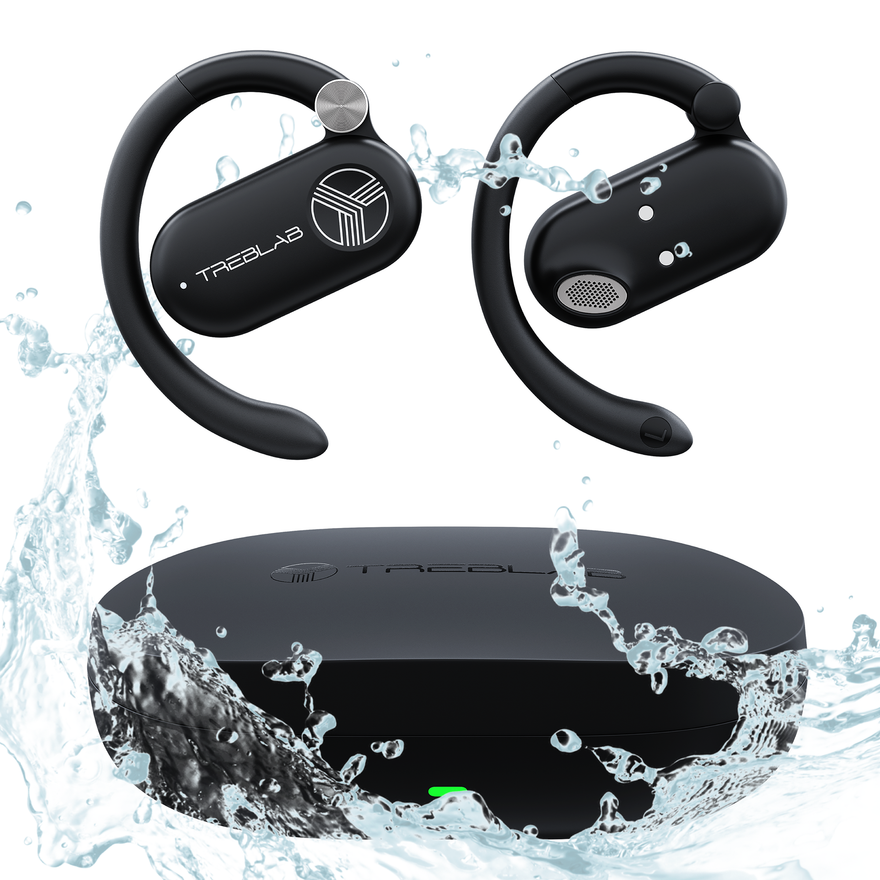
TREBLAB X-Open
Best Earbuds for Conversation
Compact Charging Case for Extended Playtime
The sleek charging case provides an additional 30 hours of power, making it easy to carry and ensuring your loudest wireless earbuds are always ready for use.
Open-Ear Design for Awareness
The open ear loudest earbuds on the market keep you aware of your surroundings while still enjoying high-quality audio, ideal for outdoor activities and safe workouts.
What Makes Earbuds Work for Conversation?

Most earbuds are designed for isolation — they block the outside world so you can focus on your audio. That's fine for commutes and workouts, but it's the opposite of what most conversational situations require. When you're at a desk, in a meeting, or out running errands, you need to hear people around you just as much as you need to hear your calls.
There are two hardware approaches to solving this, and one software approach.
Open-ear and semi-open designs
Open-ear and semi-open designs let ambient sound pass around or through the driver housing naturally. You hear both your audio and the room — no mode switching, no processing lag. The TREBLAB X-Open and Jabra Elite 10 both use this approach, though in different ways: the X-Open sits completely outside the canal on a hook, while the Elite 10 uses a semi-open EarGel fit that rests at the entrance without sealing it.
Closed in-ear earbuds with transparency mode
Closed-in-ear earbuds with transparency mode use a digital workaround: external microphones capture ambient sound and route it into the audio stream in real time. The quality gap between implementations is significant. Google's Conversation Detection automatically switches to transparency when it detects you're speaking. Sony's WF-1000XM6 offers three adaptive ambient profiles. Jabra's HearThrough is widely regarded as one of the most natural-sounding implementations available. Cheaper or less-optimized versions tend to introduce hiss, processing delay, or tinny voice reproduction — all of which make live conversation feel unnatural.
Microphone quality
Microphone quality is the third factor. For phone calls, six or more beamforming microphones with ENC (Environmental Noise Cancellation) is the practical baseline above $100. Samsung's Galaxy Buds3 Pro goes further with AI-based voice reconstruction that actively rebuilds the speech signal in noisy environments. The difference shows up most clearly when you're calling from a street or a café.
Top 10 Earbuds for Conversation at a Glance

|
Model |
Fit Type |
Mic System |
Weight (per unit) |
Battery Life |
IPX Rating |
Price |
|
TREBLAB X-Open |
Open-ear hook |
Dual ENC |
8.9 g |
10h / 40h total |
IPX5 |
$49.97 |
|
Google Pixel Buds Pro 2 |
Closed in-ear |
3-mic + voice accelerometer |
4.7 g |
8h ANC on / 30h total |
IP54 |
~$229 |
|
Beats Fit Pro |
Closed in-ear + wing tip |
6-mic array (H1 chip) |
~6.0 g |
6h ANC on / 24h total |
IPX4 |
~$160 |
|
Sony WF-1000XM6 |
Closed in-ear |
8 adaptive mics (QN3e) |
6.2 g |
8h ANC on / 24h total |
IPX4 |
~$300 |
|
Samsung Galaxy Buds3 Pro |
Closed in-ear |
3 SWB VPU + AI |
5.4 g |
6h ANC on / 32h total |
IP57 |
~$200 |
|
Anker Liberty 4 NC |
Closed in-ear |
6 beamforming ENC |
~5.8 g |
10h / 50h total |
IPX4 |
~$100 |
|
JBL Live Pro 2 |
Closed in-ear |
6 beamforming mics |
~5.5 g |
10h / 40h total |
IPX5 |
~$150 |
|
Nothing Ear (2024) |
Closed in-ear |
6-mic hybrid |
~4.5 g |
8.5h ANC on / 40.5h total |
IP54 |
~$149 |
|
Jabra Elite 10 |
Semi-open in-ear |
6 MEMS mics |
5.7 g |
8h / 36h total |
IP57 |
~$250 |
|
Bose QuietComfort Ultra Earbuds |
Closed in-ear |
8-mic array |
6.2 g |
6h / 24h total |
IPX4 |
~$249 |
Fit type legend:Open-ear hook = driver sits outside the canal entirely, no insertion; Closed in-ear = full canal seal, isolation-first; Semi-open in-ear = rests at canal entrance without sealing; In-ear + wing tip = closed seal with stabilizer fin.
Our Top 10 Earbuds for Conversation Reviewed and Tested
Conversation quality depends on three things working together: how sound enters your ear, how your voice is picked up, and how naturally you can hear the people around you. The ten reviews below cover each of those dimensions.
TREBLAB X-Open — Best Overall Earbuds for Conversation

Rating: ⭐⭐⭐⭐⭐
The X-Open uses an over-ear hook with a 14.2mm driver that sits completely outside the ear canal. There's no seal, no insertion, and no transparency mode to activate — you hear your surroundings the same way you do without earbuds. Dual ENC microphones ensure call quality, and the 40-hour total battery life makes it a full-day option at under $50.
Detailed Specifications:
- Fit Type: Open-ear hook (no canal insertion)
- Driver Size: 14.2mm dynamic
- Bluetooth Version: 5.4
- Battery Life (earbuds): 10 hours
- Battery Life (total with case): 40 hours
- Weight (per earbud): 8.9 g
- Water Resistance: IPX5
- Microphone: Dual ENC
- Charging: USB-C + 5W wireless
- Price: $49.97
+ Pros:
- Full ambient awareness — always on, no toggle
- 14.2mm driver — largest in this list
- IPX5 — stronger water resistance than most rivals
- 40h total battery at this price — unmatched
- USB-C + wireless charging
- Siri / Google Assistant support
- Cons:
- Heavier per earbud than in-ear designs (8.9g)
- Open design = less bass isolation
Why it's our choice for conversation
The X-Open is the only earbud here that doesn't require any mode to make you conversationally aware. You hear people naturally, all the time, while calls stay clear through dual ENC. No other model on this list delivers that combination for less than $200.
Google Pixel Buds Pro 2

Rating: ⭐⭐⭐⭐☆
Google built Conversation Detection directly into the hardware: when you start speaking, the Pixel Buds Pro 2 automatically pause your audio and switch to Transparency mode. A voice accelerometer confirms you're talking before switching — avoiding false triggers. Three beamforming mics with wind-blocking mesh covers handle calls, though mic performance in heavy noise has received mixed reviews.
Detailed Specifications:
- Fit Type: Closed in-ear
- Driver Size: 11mm
- Bluetooth Version: Bluetooth with Tensor A1 chip
- Battery Life (earbuds): 8h (ANC on) / 12h (ANC off)
- Battery Life (total with case): 30h (ANC on) / 48h (ANC off)
- Weight (per earbud): 4.7 g
- Water Resistance: IP54
- Microphone: 3-mic beamforming + voice accelerometer
- Charging: USB-C + wireless
- Price: ~$229
+ Pros:
- Conversation Detection — automatic, hardware-level
- Lightest earbud in this list (4.7g)
- 48h total battery without ANC
- IP54 — dust and water resistant
- Gemini Live integration for AI calls
- Silent Seal 2.0 ANC — 2x stronger than predecessor
- Cons:
- Mic underperforms in loud outdoor environments
- iOS compatibility limited — full features need Android + Google account
- App not available on iOS
- Occasional software stability issues reported
- No aptX codec support
Why it's our choice for conversation
Conversation Detection removes the friction of switching modes entirely. When you speak, the earbuds respond — no tapping, no pulling out. For people who frequently switch between calls and live interaction, this automation is the most practical conversational feature on this list.
Beats Fit Pro

Rating: ⭐⭐⭐⭐☆
The Beats Fit Pro is a workout-first earbud with an H1 chip that gives iOS users full Siri integration, Spatial Audio, and fast pairing. The flexible wing tips lock the fit during high-movement use, but the closed seal means conversation awareness requires manually switching to Transparency mode. Call quality is good in quiet environments but degrades in noisy environments.
Detailed Specifications:
- Fit Type: Closed in-ear + wing tip
- Driver Size: N/A — not disclosed
- Bluetooth Version: Class 1 (Apple H1 chip)
- Battery Life (earbuds): 6h (ANC on) / 7h (ANC off)
- Battery Life (total with case): 24h (ANC on) / 27h (ANC off)
- Weight (per earbud): ~6 g
- Water Resistance: IPX4
- Microphone: 6-mic array (H1 chip)
- Charging: USB-C
- Price: ~$160
+ Pros:
- Wing tip fit — most secure on this list for movement
- 6-mic H1 array — strong iOS call quality
- Android-compatible without feature sacrifice
- Personalized Spatial Audio with head tracking
- Transparent mode solid for iOS users
- Strong value — frequently discounted
- Cons:
- No wireless charging
- ANC is weaker than Sony / Bose at this price tier
- Limited Android features vs. iOS
- IPX4 only — weakest water rating here
- Transparency mode requires manual toggle
Why it's our choice for conversation
Best option for iOS users who take calls while using the app. The wing tip holds the fit during movement, and the H1 chip keeps iPhone call handoffs seamless. For Siri-heavy workflows, no other earbud here integrates as smoothly into the Apple ecosystem.
Sony WF-1000XM6

Rating: ⭐⭐⭐⭐☆
The WF-1000XM6 runs eight adaptive microphones on the QN3e processor — three times faster than the previous chip. On calls, this translates to Sony's most accurate voice isolation to date, with the option to accept calls by nodding and reject them by shaking your head. Ambient mode offers three auto-adjusting profiles, and LDAC support means audio quality between calls is class-leading.
Detailed Specifications:
- Fit Type: Closed in-ear
- Driver Size: 8.4mm
- Bluetooth Version: 5.3 (SBC, AAC, LDAC)
- Battery Life (earbuds): 8h (ANC on)
- Battery Life (total with case): 24h (ANC on)
- Weight (per earbud): 6.2 g
- Water Resistance: IPX4
- Microphone: 8 adaptive mics (QN3e, 4 per earbud)
- Charging: USB-C + wireless
- Price: ~$300
+ Pros:
- 8 adaptive mics — most mic density on this list
- Head-gesture call controls (nod/shake)
- LDAC Hi-Res Audio Wireless certified
- 3-profile adaptive Ambient mode
- Auracast + Multipoint + Fast Pair + Swift Pair
- 10-band EQ + DSEE Extreme upscaling
- Cons:
- Most expensive option here (~$300)
- 24h total battery — shorter than mid-range rivals
- IPX4 only — no dust protection
- The case is bulkier than the XM5
Why it's our choice for conversation
Eight mics with AI processing deliver Sony's most accurate voice separation in noise. The head-gesture call controls let you answer or decline without touching the earbuds. For professionals who take calls all day in mixed environments, no other earbud here comes closer.
Samsung Galaxy Buds3 Pro

Rating: ⭐⭐⭐⭐☆
The Buds3 Pro is the only earbud on this list that uses AI-based voice reconstruction — when your call audio degrades in noise, the system actively reconstructs missing voice data rather than just filtering. Super Wideband microphones capture a broader voice-frequency range than standard beamforming arrays, and their IP57 rating makes them the most water-resistant closed-in-ear option in the group.
Detailed Specifications:
- Fit Type: Closed in-ear (canal, 2-way speaker)
- Driver Size: 6.1mm planar tweeter + 10.5mm dynamic
- Bluetooth Version: 5.4
- Battery Life (earbuds): 6h (ANC on) / 7h (ANC off)
- Battery Life (total with case): 32h (ANC on) / 30h (ANC off)
- Weight (per earbud): 5.4 g
- Water Resistance: IP57
- Microphone: 3 VPU + Super Wideband AI noise reconstruction
- Charging: USB-C + wireless
- Price: ~$200
+ Pros:
- IP57 — submersible, best water rating in this list
- AI voice reconstruction — unique at this tier
- Super Wideband mic — broader voice frequency capture
- Real-time AI language translation (Samsung devices)
- BT 5.4 — latest Bluetooth version in this list
- Dual-driver per earbud (planar + dynamic)
- Cons:
- AI features require a recent Samsung Galaxy device
- 6h ANC battery — below average for the price
- iOS support is limited to basic audio only
- Companion app locked to Galaxy ecosystem
Why it's our choice for conversation
AI voice reconstruction is the standout feature for calls in genuinely noisy environments — cafés, streets, transit. Rather than just cutting noise, it rebuilds the voice signal. For Android users on Samsung devices who make calls in loud places, this is the most technically advanced option here.
Anker Soundcore Liberty 4 NC

Rating: ⭐⭐⭐⭐☆
Six beamforming mics with an AI call algorithm make the Liberty 4 NC punch well above its $100 price on calls. Battery life at 50 hours total is the highest on this list, adaptive ANC 2.0 adjusts to your ear canal shape in real time, and the Soundcore app offers one of the most complete EQ and personalization systems at any price point.
Detailed Specifications:
- Fit Type: Closed in-ear
- Driver Size: 11mm custom-tuned
- Bluetooth Version: 5.3 (SBC, AAC, LDAC)
- Battery Life (earbuds): 10h (ANC off) / ~8h (ANC on)
- Battery Life (total with case): 50h
- Weight (per earbud): ~5.3 g
- Water Resistance: IPX4
- Microphone: 6 beamforming ENC + AI
- Charging: USB-C + wireless
- Price: ~$100
+ Pros:
- 50h total battery — longest in this list
- 6-mic AI call system at $100 price point
- LDAC support — class-leading at this price
- Adaptive ANC 2.0 — ear-canal-aware
- 10-min fast charge = 4h extra
- Soundcore app — 22 EQ presets + HearID personalization
- Cons:
- IPX4 only — below some rivals in water resistance
- ANC is not as strong as Sony / Bose flagships
- Transparency mode sounds less natural than premium options
- Stem design is bulkier than stemless rivals
- Bass-heavy default tuning — not neutral out of the box
Why it's our choice for conversation
At $100, the 6-mic AI beamforming system delivers call clarity that rivals earbuds at twice the price. If your main use case is phone calls and you need long battery life without spending on premium features, this is the clear value pick.
JBL Live Pro 2

Rating: ⭐⭐⭐⭐☆
The Live Pro 2 fits six beamforming microphones into a $150 earbud alongside JBL's VoiceAware feature, which routes your own voice back into the earbuds so you can control how loudly you speak during calls. True Adaptive ANC automatically adjusts to surroundings, and IPX5 makes it one of the more water-resistant mid-range options. Smart Ambient mode lets ambient sound in without removing the earbuds.
Detailed Specifications:
- Fit Type: Closed in-ear (stick, Oval Tubes design)
- Driver Size: 11mm
- Bluetooth Version: 5.0
- Battery Life (earbuds): 10h
- Battery Life (total with case): 40h
- Weight (per earbud): N/A — not disclosed
- Water Resistance: IPX5
- Microphone: 6 beamforming mics + VoiceAware
- Charging: USB-C + Qi wireless
- Price: ~$150
+ Pros:
- VoiceAware sidetone — hear your own voice on calls
- IPX5 — better water resistance than most mid-range
- 40h total battery with 15-min fast charge option
- True Adaptive ANC — environment-aware
- 6 beamforming mics with wind noise reduction
- Qi wireless charging is included
- Cons:
- Bluetooth 5.0 — the oldest version in this list
- Weight not disclosed
- ANC performance below Sony / Bose at higher prices
- Smart Ambient less natural-sounding than premium modes
- Stem design less compact than stemless rivals
Why it's our choice for conversation
VoiceAware is a practical feature that most earbuds skip: it helps you modulate your speaking volume on calls rather than unconsciously shouting. For people who take calls in open offices or public spaces where voice awareness matters, this is worth the $150.
Nothing Ear (2024)

Rating: ⭐⭐⭐⭐☆
The Nothing Ear (2024) brings 11mm ceramic-diaphragm drivers, LDAC + LHDC 5.0 codec support, and a six-mic hybrid call system to the $149 price point. At 4.6g per earbud, it's the lightest closed-fit in-ear on this list, and the Nothing X app offers one of the better-designed personalization experiences in this segment. Maximum volume has been flagged as slightly low in outdoor environments.
Detailed Specifications:
- Fit Type: Closed in-ear
- Driver Size: 11mm (ceramic diaphragm)
- Bluetooth Version: 5.3 (SBC, AAC, LDAC, LHDC 5.0)
- Battery Life (earbuds): 8.5h (ANC off) / 5.2h (ANC on)
- Battery Life (total with case): 40.5h (ANC off) / 24h (ANC on)
- Weight (per earbud): 4.6 g
- Water Resistance: IP54 (buds) / IP55 (case)
- Microphone: 6-mic hybrid (3 per earbud)
- Charging: USB-C + wireless
- Price: ~$149
+ Pros:
- Lightest closed in-ear here (4.6g)
- LDAC + LHDC 5.0 — widest codec support in this list
- IP54 buds + IP55 case — case is better protected than most
- Ceramic drivers — lower distortion than standard dynamic
- ChatGPT voice integration via the Nothing X app
- 10-min fast charge = 10h playback
- Cons:
- Maximum volume limited — problematic outdoors
- ANC (45dB) is weaker than Sony / Bose at a similar price
- Transparency mode slightly processed-sounding
- Pinch controls difficult for larger hands
- ANC noticeably alters sound balance
Why it's our choice for conversation
Lightest closed-in-ear option here with full LDAC support and a six-mic hybrid system. For someone who wants comfortable all-day wear and takes calls primarily indoors or in moderate-noise environments, the combination of low weight and good call clarity at $149 is genuinely competitive.
Jabra Elite 10

Rating: ⭐⭐⭐⭐☆
Jabra scanned 62,000 ears to design the EarGel semi-open fit — the result sits at the entrance of the canal without sealing it, giving partial natural ambient awareness alongside a six-MEMS-mic array the company has refined over years of professional communications hardware. HearThrough transparency mode is widely regarded as one of the most natural-sounding implementations in consumer earbuds. IP57-rated case and earbuds.
Detailed Specifications:
- Fit Type: Semi-open in-ear (EarGel — no full canal seal)
- Driver Size: 10mm
- Bluetooth Version: 5.3 (SBC, AAC, LC3/LC3plus ready)
- Battery Life (earbuds): 8h
- Battery Life (total with case): 36h
- Weight (per earbud): 5.7 g
- Water Resistance: IP57
- Microphone: 6 MEMS beamforming
- Charging: USB-C + Qi wireless
- Price: ~$250
+ Pros:
- Semi-open EarGel fit — partial natural ambient awareness
- 6 MEMS mics — from a company built on professional comms
- HearThrough — most natural-sounding transparency mode tested
- IP57 — dust and water resistant, same as Galaxy Buds3 Pro
- Dolby Atmos + head tracking
- Multipoint + Find My + Qi wireless charging
- Cons:
- Semi-open fit = less bass than fully sealed rivals
- Battery (36h total) — below Anker, JBL, TREBLAB
- $250 price — premium tier
- App required for Dolby spatial features and firmware updates
- Fit is less secure during high-impact activity
Why it's our choice for conversation
The EarGel semi-open design is the closest a closed-style earbud gets to natural ambient awareness — no processing, no mode switching, just partial pass-through from the fit architecture itself. Combined with Jabra's six-MEMS mic array and HearThrough, this is the best dual-use option for people who alternate between focused calls and live conversation throughout the day.
Bose QuietComfort Ultra Earbuds

Rating: ⭐⭐⭐⭐☆
The QC Ultra Earbuds earned their reputation on ANC and audio quality, not call performance — and that trade-off is visible in the specs. The eight-mic array delivers clean call quality in moderate noise, but multiple testers note that it doesn't match AirPods Pro or Jabra Elite 10 in heavy outdoor conditions. CustomTune calibrates the sound signature to your ear canal each time you power on. Immersive Audio spatial mode cuts battery from 6h to 4h.
Detailed Specifications:
- Fit Type: Closed in-ear
- Driver Size: N/A — not disclosed
- Bluetooth Version: 5.3 (SBC, AAC, aptX Adaptive)
- Battery Life (earbuds): 6h (standard) / 4h (Immersive Audio on)
- Battery Life (total with case): 24h
- Weight (per earbud): 6.2 g
- Water Resistance: IPX4
- Microphone: 8-mic array (CustomTune)
- Charging: USB-C (no wireless charging)
- Price: ~$249
+ Pros:
- Industry-leading ANC — best in class at this tier
- CustomTune per-session audio calibration
- aptX Adaptive codec support
- 8-mic array — highest mic count alongside Sony
- Comfortable fit — validated across multiple long-term reviews
- Self Voice feature — hear yourself clearly on calls
- Cons:
- No wireless charging — notable at this price
- 6h battery — shortest per-charge in this list
- Call quality behind Jabra / Samsung in heavy outdoor noise
- IPX4 only — no dust resistance
- Immersive Audio further cuts battery to 4h
Why it's our choice for conversation
The Self Voice feature is uniquely useful: it routes your own voice back through the earbuds at a controllable volume so you don't over-project on calls. Combined with world-class ANC that keeps the other person's voice clear of background sound, the QC Ultra Earbuds are the best choice for call-heavy users in loud offices or transit environments.
How to Choose Earbuds for Conversation

Fit type eliminates most of the field before you compare anything else. Open-ear and semi-open designs give you ambient awareness by default. Closed-in-ear designs seal you off and require a transparency mode to compensate — and how well that mode sounds is what you're actually paying for in a conversation-focused earbud.
Know Your Conversation Context
Define where you'll use these first. A home-office worker taking Teams calls needs good call clarity and battery life — transparency mode barely matters. Someone who commutes on calls or works in an open-plan office needs both strong mic noise rejection and the ability to hear people nearby. If you regularly speak to people face-to-face while wearing earbuds, a closed model with a weak transparency mode will frustrate you daily.
Start with Fit Type
Open-ear hooks never isolate you from the room. Semi-open fits provide partial natural pass-through. Closed-in-ear with a strong transparency mode can approximate awareness digitally — Jabra's HearThrough and Google's Conversation Detection are the benchmarks. A closed-in-ear with a mediocre transparency mode keeps you acoustically cut off unless you pull the earbuds out. Rule those out first.
Mic Quality and Background Noise Rejection
Six or more beamforming mics with ENC is the practical baseline above $100. Beyond mic count, processing matters more than the number of mics — Samsung's three-mic AI voice reconstruction outperforms several six-mic arrays because it rebuilds degraded speech rather than just filtering noise. At the budget end, the TREBLAB X-Open's dual ENC system performs well because its open design reduces baseline noise before the mic even activates.
Transparency Mode and Ambient Awareness
Test or read reviews specifically for how natural voices sound through transparency mode — not just whether it exists. Hiss, tinny character, or a slight lag all make live conversation feel off. Jabra HearThrough and Google Conversation Detection have the strongest reputations here. Under $100, the TREBLAB X-Open solves this through open-ear hardware rather than software. At $150–$200, Nothing Ear and Samsung Buds3 Pro are serviceable. Above $250, Sony and Bose are built more for ANC and audio quality — pick them if outgoing call clarity matters more to you than live ambient interaction.
FAQ
What are the best earbuds for conversation on the market?
The TREBLAB X-Open leads for open-ambient use — full awareness by default, dual ENC for calls, lowest price on this list. For closed-in-ear, the Jabra Elite 10 has the best transparency mode for live conversation, and the Sony WF-1000XM6 has the strongest mic system for calls in noise.
Do open-ear earbuds sound worse than in-ear earbuds?
They deliver less bass and isolation than sealed designs. For calls, podcasts, and speech, the difference is minimal — voices often sound more natural because there's no occlusion from canal sealing. For bass-heavy music, closed in-ear earbuds win.
What is transparency mode, and why does it matter for conversation?
It uses external microphones to mix ambient sound into your audio in real time. A good implementation lets you hold a face-to-face conversation without removing the earbuds. A poor one introduces hiss, tinny vocal character, or processing lag that makes live interaction feel unnatural.
How many microphones do I need for clear call quality?
Six or more beamforming mics with ENC is the baseline for noisy environments. That said, mic count matters less than processing — Samsung's three-mic AI system outperforms some six-mic arrays because it reconstructs the voice signal rather than just filtering noise around it.
Are earbuds for conversation the same as earbuds for phone calls?
Not entirely. Phone call earbuds prioritize outgoing mic quality — how your voice sounds to the other person. Conversation earbuds also need to handle incoming ambient sound — how clearly you hear people around you. The best options here address both.
How long after getting new earbuds should I test the mic quality for calls?
Test immediately — mic performance doesn't improve with use. Call in a quiet room first to set a baseline, then test in a café or on a street. If the person on the other end reports significant background noise in moderate environments, a firmware update is unlikely to fix it.
Conclusion
The clearest recommendation for most people on this list is the TREBLAB X-Open. At $49.97, it is the only earbud here that delivers full ambient awareness through hardware — no mode to toggle, no transparency processing, no latency — while dual ENC keeps calls clean. The 40-hour battery, IPX5 rating, and 14.2mm drivers make it a complete daily-use option at a price that undercuts every other model here by at least $50.
For specific use cases, the field splits. The Jabra Elite 10 ($250) is best for people who alternate between focused calls and face-to-face interaction — the semi-open EarGel fit and HearThrough mode handle both without switching. The Sony WF-1000XM6 ($300) is the right call for professionals who need the strongest mic performance in heavy noise. The Anker Soundcore Liberty 4 NC ($100) is the standout value for call-only use, with a six-mic AI system and 50-hour battery that rival earbuds at twice the price.


